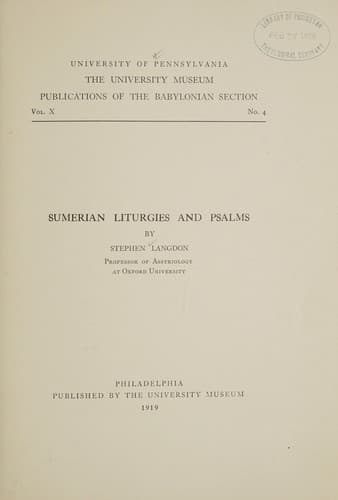
Hymns, Sumerian; Sumerian language -- Texts; Sumerians -- Religion
either by priest (_kišub_ in later terminology is the rubric of priest’s
prayers in incantations) or by penitent (_šu-il-la’s_). The absence of
prayers of private devotion in the temple library of Nippur is absolutely
inexplicable. Does it mean that the Sumerians were so deficient in
providing for the religious cure of the individual? Their emphasis of the
social solidarity of religion is truly in remarkable contrast to the
religious individualism of the Semite. But the Sumerian historical
inscriptions often contain remarkable prayers of individuals. The seals
emphasize the act of private devotion. The catalogue of their prayers
states that they possessed a good literature for private devotions. When
one considers the evidence which induces to assume that they possessed
such a literature, its total absence in every Sumerian collection is an
enigma which the writer fails to explain.
In the introduction to part two of this volume(24) the writer has
emphasized the peculiarly rich collection of tablets in this collection
pertaining to the cults of deified kings. In the present part is published
a most important tablet of that class. This liturgy of the compiled type
in six _kišubs_ sung in the cult of the god-man Ishme-Dagan, fourth king
of the Isin dynasty, is unique in the published literature of Sumer. Its
musical intricacy and theological importance have been duly defined on
pages 245-247. With the publication of these texts the important song
services of the cults of deified kings are exhausted. In addition to the
texts of this class translated or noted in part two, I call attention to
the very long text concerning Dungi, king of Ur, published by BARTON,
_Miscellaneous Babylonian Inscriptions_ No. 3. In that extremely long poem
in six columns of about 360 lines(25) there are no rubrics, which shows at
once that it is not a cult song service. Moreover, Dungi had not been
deified when the poem was written. It is really an historical poem to this
king whose deification had at any rate not yet been recognized at Nippur.
It belongs in reality to the same class of literature as the historical
poem on his father Ur-Engur, translated on pages 126-136.
Public-domain text, read in full here on John Shaqi.
Reviews
Reviews
No reviews yet
Be the first to share your thoughts on this work.
Join the Discussion
Join the discussion
Sign in to leave a comment or review.
Sign InorCreate an account