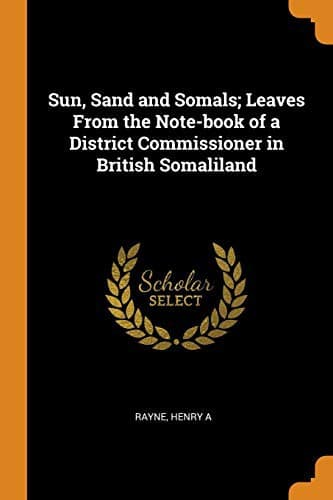
Sun, Sand and Somals: Leaves from the note-book of a District Commissioner in British SomalilandRayne, Henry A.
History
Sun, Sand and Somals: Leaves from the note-book of a District Commissioner in British Somaliland
Rayne, Henry A.
British Somaliland
Tribal location--European Protectorates--Characteristics--The
old Akil--A tale of treachery.
From Egypt to the Juba River the whole north-east African coast
is held by three powers, Italy, France, and England. The Italian
colony, now known as Eritrea, grew from a small settlement at, or
near, Assab, where the Italian flag was hoisted for the first time
in 1879. Excepting that most of the coast-line in this colony is
populated--in places very sparsely--by the Danakil, a tribe closely
resembling the Somal tribe in temperament, customs, and religion, it
has no concern with Somaliland. The Danakil territory extends as far
south as the Issa Somal's northern grazing grounds, near Tajura in
French territory. From Tajura to almost the mouth of the Tana River,
in British East Africa, the coast lands, and much of the interior,
are held by the Somals.
In 1888 the Italians turned their attention to Southern Somaliland,
and by 1894 had established a protectorate over the whole coast
between Biaso, on the Gulf of Aden, and the mouth of the Juba
River. The Somal tribes south of the mouth of the Juba, and west of
that river, ultimately came under the jurisdiction of the British
East African government; so that, nowadays, we have, from north
to south, Eritrea, French Somaliland, British Somaliland, Italian
Somaliland, and that part of East Africa inhabited by Somals and
known as Jubaland.
Somaliland, French, English, and Italian, is peopled by a race
possessed of such peculiar and contradictory temperamental
characteristics, that, were the accident or influence of environment
entirely ignored, and this people judged by purely European
standards, it might well be classed as a race of maniacs. To bear
out the truth of this statement is Burton's description of the
Somals who live in the vicinity of Zeila. "In character the Esa
are childish and docile, cunning and deficient in judgment, kind
and fickle, good-humoured and irascible, warm-hearted and infamous
for cruelty and treachery." This description, which cannot be
contradicted, might well be applied to the whole Somal race, and it
describes a people whose psychology it is impossible for a European
mind, with no experience of them, to understand and explain. To the
average European, and nearly all other African tribes, the name of
Somal is anathema.
It follows that Somals are a people who require very careful
handling, and, fortunately for them, the three powers with whom they
are most directly concerned have followed the more humane method,
when dealing with these brave _difficile_ people, of interfering as
little as possible with native custom--even where this custom is
sometimes contrary to European ideas of right--so long as it affects
only themselves, in preference to an endeavour to enforce European
standards by the employment of force.
Public-domain text, read in full here on John Shaqi.
Reviews
Reviews
No reviews yet
Be the first to share your thoughts on this work.
Join the Discussion
Join the discussion
Sign in to leave a comment or review.
Sign InorCreate an account