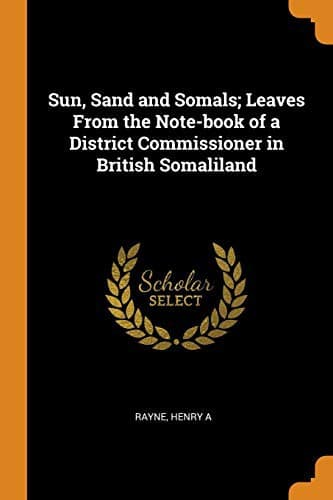
Sun, Sand and Somals: Leaves from the note-book of a District Commissioner in British SomalilandRayne, Henry A.
History
Sun, Sand and Somals: Leaves from the note-book of a District Commissioner in British Somaliland
Rayne, Henry A.
British Somaliland
As Englishmen, Frenchmen, and Italians alike have lost their lives
by acts of treachery that can only be described as the acts of
madmen, the lesson learned has been that, no matter how safe things
may appear on the surface, it is never wise to relax ordinary
precaution. The Somal has no sense of reverence, if I may use the
expression, and considers himself as good a man, and, like all
madmen, as sane a man as anyone else in the world. One may expect no
supine servility from him, and the man who looks for it will only
find trouble instead. In dealing with Eastern natives the European
is not unlikely to become somewhat "spoiled," and, unless he has a
very level head, may quite easily lose a due sense of proportion as
to his relative importance with other peoples in this world.
To-day I received this note from an Indian clerk:
"SIR,--I respectfully request your merciful honour to arrange
for myself and Mr ---- two riding camels to go to the garden
this Saturday at three p.m. For which act of kindness we shall
be highly obliged."
Of course I let him have the camels, and was thanked so profusely
that I began to feel I was a rather wonderful fellow, and had done
something really magnanimous. But my conceit was about to receive a
rude shock.
Shortly after the camel incident a dirty old Akil walked into my
office, and, with an abrupt "salaam," held out a grimy paw for me to
shake. I shook.
The old gentleman had come in from the bush to draw his salary,
which I was prepared to pay him as condescendingly as I had lent
camels to the clerk. It is hard to explain what a pleasant sensation
of exaltation even the most modest of men may feel when seated on a
dais behind a desk, with an inspector of police--who bows every time
he is looked at--on his left; an interpreter on his right, who would
lick his boots for a rise of pay; a clerk who stands up, and says
"Sir" as if he meant it, every time he is spoken to; and a real live
savage in front of him who has come to ask for pay, and who is an
inferior to whom one can grant favours.
I asked after the Akil's health and his cattle, endeavouring to
convey I was not above taking an interest in his affairs. Had there
been good rain, and was the grazing good out his way? Was the
political situation quite satisfactory? He answered all my questions
with civility, and after some little time turned to the interpreter
and said: "I've been nearly thirty years an Akil and this is the
first time I have been asked immediately on arrival in Zeila for the
news of the district. This officer is unlike the other sahibs."
I took this remark as a great compliment to my keenness. For there
have been some very clever sahibs stationed here during the past
thirty years, all of whom the old boy before me must have met
and had dealings with. I was so flattered that I fairly oozed
condescension.
"Ask him why I am different to the other sahibs," I said.
Public-domain text, read in full here on John Shaqi.
Reviews
Reviews
No reviews yet
Be the first to share your thoughts on this work.
Join the Discussion
Join the discussion
Sign in to leave a comment or review.
Sign InorCreate an account