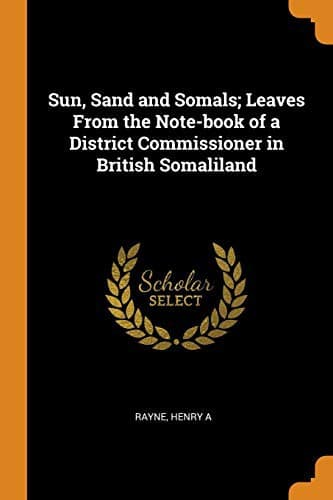
Sun, Sand and Somals: Leaves from the note-book of a District Commissioner in British SomalilandRayne, Henry A.
History
Sun, Sand and Somals: Leaves from the note-book of a District Commissioner in British Somaliland
Rayne, Henry A.
British Somaliland
It was useless showing temper. I told Mahomed, the interpreter,
we would ride back to the Hargeisa road and wait for the baggage
camels. Mahomed, the interpreter, told me that that was impossible,
because the baggage camels, having left the Hargeisa road at the
camp, were following an entirely different road to the one we had
come by. We went on to the police camp, as Mahomed had all along
intended, and arrived at noon.
"And now," said I, "I shall have a cup of tea and some biscuits."
Every day since leaving Zeila we had carried the articles necessary
for such a meal in our saddle-bags, but to-day they had been left
behind. Why? Because Mahomed, the interpreter, and my boy arranged
that I should lunch with the four Sahibs who are not here.
We are now on a high plateau. The country is undulating, the soil
fair and the grazing good. There are many patches of cultivation,
the first I have seen in Somaliland. Ughaz Elmi Warfa (Ughaz is a
title), the head of the Gadabursi tribe, came to see me. He was
accompanied by a party of horse and foot men. The Ughaz, a tall,
crafty-looking old man, sat beside me on a deck chair, produced
by the Somal jemadar in charge of the police post; whilst his men
gave a demonstration. First, one by one, came the horsemen at full
gallop to about three yards away from where I sat, and just as a
collision seemed inevitable the poor little brutes of ponies were
pulled on to their haunches. For the horses' sake I begged this
should stop. Then the horsemen advanced in line and at a walk,
halting in front of me. One of them sang that they were the people
who lived on the border, had been looted by the Amhara, had no
peace; stood between two men, and should they talk to the man before
them the other kicked them from behind. Theirs was indeed a hard
lot. The man who sang was a wild-looking fellow with fuzzy-wuzzy
hair. He carried a spear and shield. Personally speaking, I should
not choose him as a good subject to kick from behind, but if I lived
with him, and he sang much, I should be strongly tempted to do so.
The horsemen dismounted, came forward, shook hands, turned away and
off-saddled. This done, they joined the footmen waiting a hundred
paces away. There was a wait of some minutes whilst a warrior
was being persuaded to come out and lead the dance. When I was
sufficiently impressed with his importance he stepped out in front
of his comrades who were standing in line. Stepping it nimbly up
and down before them as they sang, he performed some quite clever
evolutions. At regular intervals he would rush forward, stab his
spear in the ground, sink on his knees, and, bending his body
right back, act the wounded warrior. Such was the signal for the
line to advance towards him with a rush, and thus he led it close
to my chair. Now and again a warrior carrying his spear at the
charge would run forward, stop before me, and salute with the word
"_Mutt_." All this for half an hour, when I politely requested it
should cease.
Public-domain text, read in full here on John Shaqi.
Reviews
Reviews
No reviews yet
Be the first to share your thoughts on this work.
Elsewhere in the archive
Join the Discussion
Join the discussion
Sign in to leave a comment or review.
Sign InorCreate an account