Supplement to Harvesting Ants and Trap-Door Spiders — John Shaqi
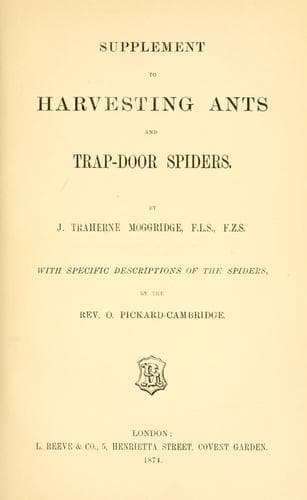
Supplement to Harvesting Ants and Trap-Door SpidersMoggridge, John Traherne
Science
Supplement to Harvesting Ants and Trap-Door Spiders
Moggridge, John Traherne
Ants; Trap-door spiders
Now these worker ants are destitute of stings, and I can only suppose
that their power of combination, stronger jaws and more horny coats,
have gained them this immunity. I remarked that the smaller lizards
appeared to have some difficulty in dealing with the males and
females which they captured, and would beat and pound them against
the stones before devouring them, while the larger ones would often
make but one mouthful of them, swallowing wings and all!
If it were not for this body-guard of workers it is difficult to
see how the males and females in such situations could ever escape.
It is also plain that if the worker harvesting ants were as liable
to be seized and devoured as their winged companions, the species
would soon become extinct, for they expose themselves more than ants
ordinarily do, and their long provision-laden trains would be almost
at the mercy of any enemy which could attack them without fear of
results.[113]
[Footnote 113: Speaking of the enemies of ants, I may mention having
seen a young robin in England picking up and swallowing the workers
of _Formica nigra_ just as if they were crumbs. I knew that birds
would eat the male and female ants, but I had thought the workers
were exempt from their attacks, and, indeed, they must be so as a
rule, for otherwise they would speedily become extinct.]
Remembering this, it is interesting to note how differently the
tiger-beetle (_Cicendela_) behaves when hunting the powerful
harvesting ants and when preying upon the weak little _Formica
(Tapinoma) erratica_; for, while it seizes the latter without taking
any precautions, it is evidently more than half afraid of the former.
I have seen this beetle lying in wait near a train of _structor_ or
_barbara_ ants, watching until some individual separated a little
from the main body, when it would rush forward and make a snap at it,
retiring again as quickly as it came. If the tiger-beetle fails to
seize its prey exactly behind the head it will let it go again, and
two or three ants are often thus cruelly mutilated before a single
one is carried off.
No doubt the beetle has learned that if once this ant clasps its
mandibles upon either antennæ or legs, nothing, not even death
itself, will make it release its hold. It therefore tries to pin the
ant in such a way that it cannot use its formidable jaws. Perhaps the
habit of forming long compact trains may have been acquired by the
ants partly with a view to guarding against attacks of this kind.
The colonies of the little _F. erratica_, on the other hand,
apparently have to trust to their habit of working under the covered
ways which they construct, as well as to their activity and great
numbers for their preservation.
I had thought that the very powerful, and, to me, disagreeable, odour
of these little ants might have rendered them distasteful to the
tiger-beetle, but this is evidently not the case.
Public-domain text, read in full here on John Shaqi.
Reviews
Reviews
No reviews yet
Be the first to share your thoughts on this work.
Join the Discussion
Join the discussion
Sign in to leave a comment or review.
Sign InorCreate an account