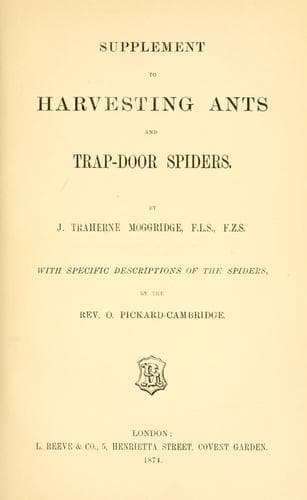
Supplement to Harvesting Ants and Trap-Door Spiders — John Shaqi
Supplement to Harvesting Ants and Trap-Door SpidersMoggridge, John Traherne
Science
Supplement to Harvesting Ants and Trap-Door Spiders
Moggridge, John Traherne
Ants; Trap-door spiders
Thus, for example, even _Atta barbara_ and _structor_, though most
closely related as species, differ in habit; the former leading a
much more active life during the winter months at Mentone than the
latter, and seeking its home rather in wild than cultivated ground.
Then what differences different ants present in respect of strength,
speed, powers of offence and defence, numerical strength of colonies,
timidity, date and frequency of departure of winged ants from the
nest, odour emitted, combativeness, architecture and selection of
localities, nature of food, nocturnal and diurnal habits, and in
many other properties and conditions! It is doubtless owing to
dissimilarity in these and other respects that it becomes possible
for so many species to co-exist within very narrow limits, so that
even three or four distinct kinds sometimes form their nests so close
to each other that their galleries interlace and almost touch.
There are probably very few conditions of life (except those
concerned with the nature and manner of obtaining food) which have a
greater influence either in keeping creatures apart or in bringing
them into collision, than those which constitute differences in their
respective periods of activity and development. Thus, two species of
which one has nocturnal and the other diurnal habits, or of which
one is dormant while the other is active, may be said to travel
different roads and to be complete strangers to one another. Complete
separation of this kind is, of course, not the rule, and the greater
number of species find themselves in more or less constant rivalry,
but possess a sufficient number of points of dissimilarity in habit
and requirements to make their co-existence possible.
It is curious to note what little differences, as they seem to us,
may determine the fate of an ant. For example, the lizards will
lie in wait for and greedily seize and devour the winged males and
females of _structor_ and _barbara_, though they dare not attack the
assembled workers. It is curious to watch the way in which these
worker ants will protect the winged ants which are about to leave
the nest, by gathering round and swarming over them. When, as often
happens, the nest is placed in an old terrace-wall, one may see the
lizards creeping along or lying moulded into the inequalities of the
stones, all having their eager eyes directed towards the swarm. One
may then see the worker ants walk with impunity straight up to the
very noses of the lizards, while the male or female which should
chance to straggle in the same direction would infallibly be eaten
up. The lizards plainly show their fear of the workers by the way in
which, when they make up their mind to try a dash at some outlying
part of the ant colony, they leap through the lines in the utmost
haste as if traversing a ring of fire.
Public-domain text, read in full here on John Shaqi.
Reviews
Reviews
No reviews yet
Be the first to share your thoughts on this work.
Join the Discussion
Join the discussion
Sign in to leave a comment or review.
Sign InorCreate an account