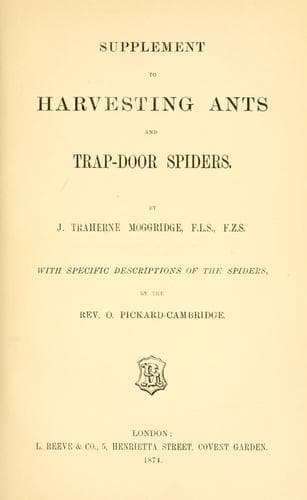
Supplement to Harvesting Ants and Trap-Door Spiders — John Shaqi
Supplement to Harvesting Ants and Trap-Door SpidersMoggridge, John Traherne
Science
Supplement to Harvesting Ants and Trap-Door Spiders
Moggridge, John Traherne
Ants; Trap-door spiders
At Mentone I have never found more than this one specimen, and the
ants among which it was domiciliated were of a species new to me
(_Camponotus_ (_Formica_) _lateralis_, Oliv.). This colony of ants
was composed of many winged males and females, as well as workers,
the last-named measuring from two and a half to three lines in
length, and black in colour. In other colonies I have found the
workers black, with red head and thorax.
Another ant, not enumerated in my list in _Ants and Spiders_, is
_Camponotus_ (_Formica_) _sylvatica_, which I detected in March last
under stones on Cap Martin, near Mentone. When disturbed, this ant
runs along with its abdomen raised vertically in the air, much as
the devil's coachhorse (_Staphylinus_) does. The same curious habit
of erecting the abdomen is found in another ant, not uncommon in
decaying wood in the South, _Crematogaster scutellaris_; and probably
all three insects adopt this threatening attitude, which is that of
the scorpion preparing to strike and sting, in order to intimidate
their enemies, though _Crematogaster_ is the only one which really
possesses a sting.
_Camponotus sylvatica_ has the same long legs and slender body as
_Formica cursor_, and is of about the same size; the workers, which
are of a dark brown colour, measuring about 3-1/2 lines in length.
Perhaps it may be well, in concluding these remarks on Harvesting
Ants, to call attention to the principal questions which still await
solution. The first is one which any observer who travels in Central
Europe during the summer may help to solve.
1. Do _any_ ants collect and store seed in Switzerland, Germany,
North France, England, or indeed in any of the colder parts of the
world?
2. What are the habits of _Atta structor_ and _A. barbara_ when
living, as they are known to do, in Switzerland, Germany, and
Northern France?
3. How do the ants contrive to preserve the seeds in their granaries
free from germination and decay?
4. How are the seed-stores of tropical ants disposed below ground,
and of what do they consist?
5. Do harvesting ants exist in the southern states of North America,
in Australia, New Zealand, or at the Cape?
SUPPLEMENT
TO
TRAP-DOOR SPIDERS.
Public-domain text, read in full here on John Shaqi.
Reviews
Reviews
No reviews yet
Be the first to share your thoughts on this work.
Join the Discussion
Join the discussion
Sign in to leave a comment or review.
Sign InorCreate an account