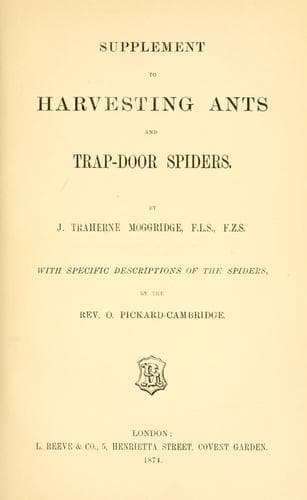
Supplement to Harvesting Ants and Trap-Door SpidersMoggridge, John Traherne
Science
Supplement to Harvesting Ants and Trap-Door Spiders
Moggridge, John Traherne
Ants; Trap-door spiders
There would doubtless be a just feeling of pride and satisfaction
in the heart of a naturalist who could say that he had made himself
thoroughly acquainted with all the species of a particular group of
animals, had learned their most secret habits, and mastered their
several relations to the objects, animate and inanimate, which
surrounded them. But perhaps a still keener pleasure is enjoyed by
one who carries about with him some problem of the kind but partially
solved, and who, holding in his hand the clue which shall guide him
onwards, sees in each new place that he visits fresh opportunities of
discovery. The latter is certainly the condition of those who take
an interest in searching out the habits and characters of trap-door
spiders; for this subject, far from being exhausted, expands under
the light of recently acquired facts, and invites research in many
parts of Europe, north as well as south.
We have only to compare the number of types of trap-door nest which
were known before the publication of _Ants and Spiders_, with those
at present recorded, to see how fruitful this field of inquiry has
already proved.
Before this little work was published, only one type of trap-door
nest was known in Europe: two new types were described in its pages,
and I have now the pleasure of being able to bring three more
hitherto unknown European types before the notice of my readers, thus
raising the number to six in all. I do not include in these six types
the very curious, and still imperfectly-known nest of _Atypus_;[122]
a spider which is a true representative of the trap-door group as
far as its structural characters are concerned, but which, although
it excavates a silk-lined burrow in the earth, does not appear to
construct any kind of door at the mouth of its tube.
[Footnote 122: See _Ants and Spiders_, page 78. _Atypus_ belongs to
the sub-family _Atypinæ_, a division which does not include any of
the _Nemesias_ or _Ctenizas_, and of which indeed _Atypus_ is the
only European representative.]
Much uncertainty still hangs over the habits of this spider, as the
facts hitherto recorded, though perfectly authentic, are difficult
to piece together into a satisfactory whole. One thing, however,
is clear, and that is, that the nests and habits of the spiders of
the genus _Atypus_ (of which, as Mr. Pickard-Cambridge, informs me,
two if not three distinct species inhabit England) merit attentive
study, and would most certainly repay it. Hastings, Portland, the
coast of Dorsetshire, and the neighbourhood of London and Exeter, are
the habitats hitherto cited for this spider, but I cannot doubt its
existence in many sheltered localities on the south coast of England.
The most recent contribution to our knowledge of this genus is
contained in a paper by M. Eugène Simon,[123] who describes three
species (two of which are new), as inhabiting France, and it remains
to be ascertained whether our British _Atypi_ agree in their
characters with any of these.
Public-domain text, read in full here on John Shaqi.
Reviews
Reviews
No reviews yet
Be the first to share your thoughts on this work.
Join the Discussion
Join the discussion
Sign in to leave a comment or review.
Sign InorCreate an account