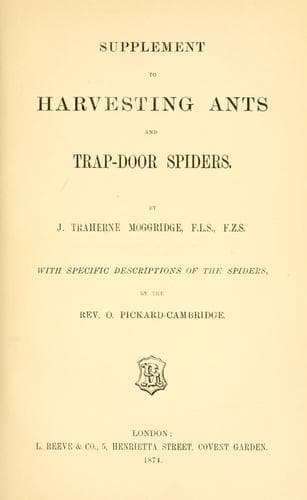
Supplement to Harvesting Ants and Trap-Door SpidersMoggridge, John Traherne
Science
Supplement to Harvesting Ants and Trap-Door Spiders
Moggridge, John Traherne
Ants; Trap-door spiders
Looked at in this light, the present pages and those of the
preceding work may be regarded as so many drawers in our _Cabinet
of Habits_, and though, as we open drawer after drawer, many gaps
and blank spaces remind us how much remains to be done in order to
complete the collection, yet the interest and suggestiveness of
the specimen-facts already secured, should encourage and direct us
onwards. There have not been wanting instances in which my readers
have associated themselves with me in the way indicated, and it is
with pleasure, when reviewing the entire work, that I recall how
many of its most interesting features are due to the researches and
assistance of friends,[109] and commemorate at once their discoveries
and unfailing kindness. I had certainly expected that before this
time some new species of harvesting ants would have been discovered,
either on the Riviera, where attention has been especially called to
the subject, or in other parts of Europe, where dissimilar conditions
might have been expected to be associated with a different fauna; but
this has hitherto not been the case.
[Footnote 109: To all who have rendered me this valuable help I tender
my cordial thanks. I am under very special obligations to Mr.
Pickard-Cambridge, for descriptions of spiders, and to Mr. F. Smith
for the names of the Ants; assistance which I should have found it
almost impossible to dispense with or to replace.]
One might naturally suppose that if harvesting ants were discovered
in localities very widely distant from each other, they would prove
to belong to different species, but thus far, both in Europe and
Northern Africa, it is the same two well-known species of _Atta
barbara_ and _A. structor_ that constantly reappear.
For instance, I have recently learned that harvesting ants are found
at Cadenabbia on the lake of Como, and at Montpellier in Southern
France; but on examination, the ants from the former place are
clearly seen to belong to the species _structor_, and those from
Montpellier to the two species _structor_ and _barbara_.
Public-domain text, read in full here on John Shaqi.
Reviews
Reviews
No reviews yet
Be the first to share your thoughts on this work.
Join the Discussion
Join the discussion
Sign in to leave a comment or review.
Sign InorCreate an account