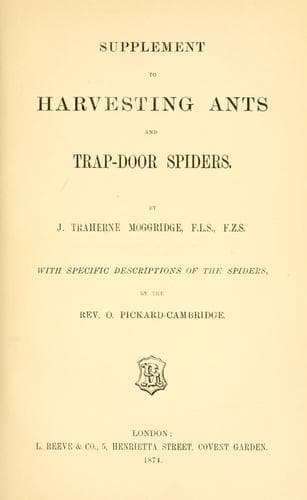
Supplement to Harvesting Ants and Trap-Door Spiders — John Shaqi
Supplement to Harvesting Ants and Trap-Door SpidersMoggridge, John Traherne
Science
Supplement to Harvesting Ants and Trap-Door Spiders
Moggridge, John Traherne
Ants; Trap-door spiders
I was greatly interested to receive specimens of ants, and of the
seeds which they were carrying and storing beneath the stones of a
paved road at Cadenabbia, for this is the northernmost point[110] at
which the habit of harvesting has as yet been noted. This discovery
suggests the possibility of the occurrence of the habit in the warmer
and more sheltered of the Swiss valleys. When at Montpellier in May
last I frequently observed long trains of ants bringing seeds and
small dry fruits to their nests, but these harvesters also turned
out on close inspection to be _Atta structor_ and _A. barbara_,
with its red-headed variety. These, it will be remembered, are the
only species of European ants which have as yet been proved to be
harvesters and seed-storers in the fullest sense of the term, that is
to say, which not only gather and carry seeds, but also store them in
large quantities below the surface of the ground.[111]
[Footnote 110: I have related in a note at the foot of p. 4 in _Ants
and Spiders_ how _Formica nigra_ in England, though paying no
attention to seeds generally, will sometimes collect the fresh seeds
of the sweet violet (_Viola odorata_).
When I published this account I was quite unaware that the fact that
certain English ants collect sweet violet seeds had been observed by
Mr. R. Wakefield forty years before.
This was communicated by Mr. Wakefield in a letter to Mr. John
Curtis, the substance of which was read before the Linnean Society
in 1854, and published in their Proceedings (see Proceedings of the
Linnean Society, ii. 293), where we read: "He (Mr. Wakefield) states
that he has seen the black species (_Formica nigra_, L.) for days and
nights together industriously occupied in dragging to its cells the
seeds of the common violet (_Viola odorata_, L.)
"He first noticed this fact on the 3rd of July, 1832; and he regards
it as a curious subject of inquiry for what purpose, if not for
their own future provision, they could accumulate these stores?" Mr.
Wakefield appears to accept this as evidence that these ants possess
the habit of storing seeds; but this is not so, as will be seen by
reference to my note alluded to above, and I am inclined to believe
that they collect these particular seeds either under the mistaken
belief that they are larvæ, to which when fresh they bear some
resemblance, or for the sake of some juices which they may obtain
from the fleshy appendage attached to the seed.]
[Footnote 111: Six other species belonging to the genus _Atta_ are
found in Europe, but they are all unknown to me.
It seems likely that, if other harvesting ants do exist in Europe
they may belong to one of these six species; for we have seen (_Ants
and Spiders_, p. 59) that all the ants which are known to possess
this habit are either members of the genus _Atta_ or belong to genera
closely related to it.]
Public-domain text, read in full here on John Shaqi.
Reviews
Reviews
No reviews yet
Be the first to share your thoughts on this work.
Join the Discussion
Join the discussion
Sign in to leave a comment or review.
Sign InorCreate an account