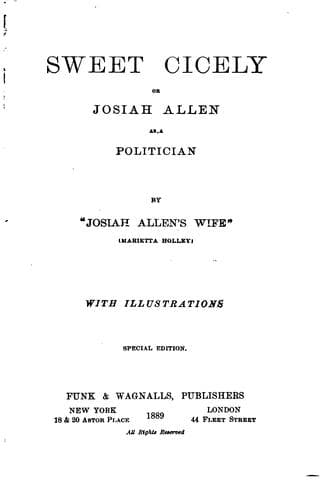
Sweet Cicely — or Josiah Allen as a PoliticianHolley, Marietta
Religion
Sweet Cicely — or Josiah Allen as a Politician
Holley, Marietta
Methodist Church (U.S.) -- Fiction; Temperance and religion -- Fiction; Women -- Suffrage -- Fiction
And for a year or so he and the chin kep' out of the way of
temptation, or ruther temptation kep' out of their way; and Cicely was
happy,--radiently happy, as only such a nature as hern can be. Her face
looked like a mornin' in June, it wus so bright, and glowing with joy
and happy love.
I visited her, stayed 3 days and 2 nights with her; and I almost forgot
to forebode about the lower part of his face, I found 'em so happy and
prosperous and likely.
Paul wus very rich. He wus the only child: and his pa left 2 thirds of
his property to him, and the other third to his ma, which wus more than
she could ever use while she wus alive; and at her death it wus to go to
Paul and his heirs.
They owned most all of the village they lived in. His pa had owned the
township the village was built on, and had built most all the village
himself, and rented the buildings. He owned a big manufactory there, and
the buildings rented high.
Wall, it wus in the second year of their marriage that that old college
chumb--(and I wish he had been chumbed by a pole, before he had ever
gone there). He had lost his property, and come down in the world,
and had to work for a livin'; moved into that village, and opened a
drinking-saloon and billiard-room.
He had been Paul's most intimate friend at college, and his evil
genius, so his mother said. But he was bright, witty, generous in a way,
unprincipled, dissipated. And he wanted Paul's company, and he wanted
Paul's money; and he had a chin himself, and knew how to manage them
that hadn't any.
Wall, Cicely and his mother tried to keep Paul from that bad influence.
But he said it would look shabby to not take any notice of a man because
he wus down in the world. He wouldn't have much to do with him, but it
wouldn't do to not notice him at all. How curius, that out of good comes
bad, and out of bad, good. That was a good-natured idee of Paul's if he
had had a chin that could have held up his principle; but he didn't.
So he gradually fell under the old influence again. He didn't mean to.
He hadn't no idee of doin' so when he begun. It was the chin.
He begun to drink hard, spent his nights in the saloon,
gambled,--slipped right down the old, smooth track worn by millions of
jest such weak feet, towards ruin. And Cicely couldn't hold him back
after he had got to slippin': her arms wuzn't strong enough.
She went to the saloon-keeper, and cried, and begged of him not to sell
her husband any more liquor. He was very polite to her, very courteous:
everybody was to Cicely. But in a polite way he told her that Paul wus
his best customer, and he shouldn't offend him by refusing to sell him
liquor. She knelt at his feet, I hearn,--her little, tender limbs on
that rough floor before that evil man,--and wept, and said,--
“For the sake of her boy, wouldn't he have mercy on the boy's father.”
But in a gentle way he gave her to understand that he shouldn't make no
change.
Public-domain text, read in full here on John Shaqi.
Reviews
Reviews
No reviews yet
Be the first to share your thoughts on this work.
Join the Discussion
Join the discussion
Sign in to leave a comment or review.
Sign InorCreate an account