Sweet Cicely — or Josiah Allen as a Politician — John Shaqi
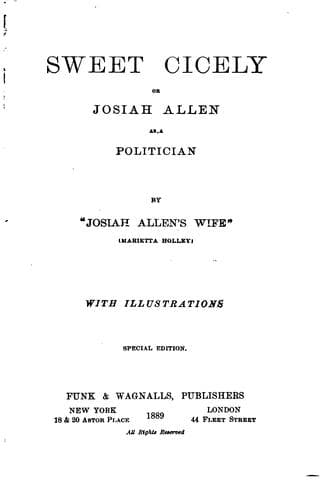
Sweet Cicely — or Josiah Allen as a PoliticianHolley, Marietta
Religion
Sweet Cicely — or Josiah Allen as a Politician
Holley, Marietta
Methodist Church (U.S.) -- Fiction; Temperance and religion -- Fiction; Women -- Suffrage -- Fiction
And he told her, speakin' in a dretful courteous way, “that he had the
law on his side: he had a license, and he should keep right on as he was
doing.”
[Illustration: CICELY IN THE SALOON.]
And so what could Cicely do? And time went on, carryin' Paul further and
further down the road that has but one ending. Lower and lower he sunk,
carryin' her heart, her happiness, her life, down with him.
And they said one cold night Paul didn't come home at all, and Cicely
and his mother wus half crazy; and they wus too proud, to the last, to
tell the servants more than they could help: so, when it got to be most
mornin', them two delicate women started out through the deep snow, to
try to find him, tremblin' at every little heap of snow that wus tumbled
up in the path in front of 'em; tremblin' and sick at heart with the
agony and dread that wus rackin' their souls, as they would look
over the cold fields of snow stretching on each side of the road, and
thinkin' how that face would look if it wus lying there staring with
lifeless eyes up towards the cold moonlight,--the face they had kissed,
the face they had loved,--and thinkin', too, that the change that had
come to it--was comin' to it all the time--was more cruel and hopeless
than the change of death.
So they went on, clear to the saloon; and there they found him,--there
he lay, perfectly stupid, and dead with liquor.
And they both, the broken-hearted mother and the broken-hearted
wife, with the tears running down their white cheeks, besought the
saloon-keeper to let him alone from that night.
The mother says, “Paul is so good, that if you did not tempt him, entice
him here, he would, out of pity to us, stop his evil ways.”
And the saloon-keeper was jest as polite as any man wus ever seen to
be,--took his hat off while he told 'em, so I hearn, “that he couldn't
go against his own interests: if Paul chose to spend his money there, he
should take it.”
“Will you break our hearts?” cried the mother.
“Will you ruin my husband, the father of my boy?” sobbed out Cicely, her
big, sorrowful eyes lookin' right through his soul--if he _had_ a soul.
And then the man, in a pleasant tone, reminded 'em,--
“That it wuzn't him that wus a doin' this. It wus the law: if they
wanted things changed, they must look further than him. He had a
license. The great Government of the United States had sold him, for a
few dollars, the right to do just what he was doing. The law, and all
the respectability that the laws of our great and glorious Republic can
give, bore him out in all his acts. The law was responsible for all
the consequenses of his acts: the men were responsible who voted for
license--it was not him.”
“But you _can_ do what we ask if you will, out of pity to Paul, pity to
us who love him so, and who are forced to stand by powerless, and see
him going to ruin--we who would die for him willingly if it would do any
good. You _can_ do this.”
Public-domain text, read in full here on John Shaqi.
Reviews
Reviews
No reviews yet
Be the first to share your thoughts on this work.
Join the Discussion
Join the discussion
Sign in to leave a comment or review.
Sign InorCreate an account