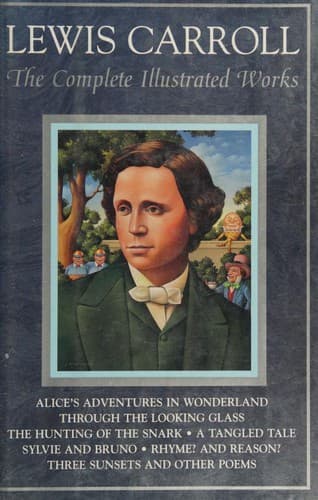
Sylvie and Bruno Concluded (Illustrated)Carroll, Lewis
Science
Sylvie and Bruno Concluded (Illustrated)
Carroll, Lewis
Fantasy fiction
Next day proved warm and sunny, and we started early, to enjoy the
luxury of a good long chat before he would be obliged to leave me.
“This neighbourhood has more than its due proportion of the _very_
poor,” I remarked, as we passed a group of hovels, too dilapidated to
deserve the name of “cottages.”
“But the few rich,” Arthur replied, “give more than their due proportion
of help in charity. So the balance is kept.”
“I suppose the _Earl_ does a good deal?”
“He _gives_ liberally; but he has not the health or strength to do more.
Lady Muriel does more in the way of school-teaching and cottage-visiting
than she would like me to reveal.”
“Then _she_, at least, is not one of the ‘idle mouths’ one so often
meets with among the upper classes. I have sometimes thought they would
have a hard time of it, if suddenly called on to give their _raison
d’être_, and to show cause why they should be allowed to live any
longer!”
“The whole subject,” said Arthur, “of what we may call ‘idle mouths’ (I
mean persons who absorb some of the material _wealth_ of a community—in
the form of food, clothes, and so on—without contributing its equivalent
in the form of productive _labour_) is a complicated one, no doubt. I’ve
tried to think it out. And it seemed to me that the simplest form of the
problem, to start with, is a community without _money_, who buy and sell
by _barter_ only; and it makes it yet simpler to suppose the food and
other things to be capable of _keeping_ for many years without
spoiling.”
“Yours is an excellent plan,” I said. “What is your solution of the
problem?”
“The commonest type of ‘idle mouths,’” said Arthur, “is no doubt due to
money being left by parents to their own children. So I imagined a
man—either exceptionally clever, or exceptionally strong and
industrious—who had contributed so much valuable labour to the needs of
the community that its equivalent, in clothes, &c., was (say) five times
as much as he needed for himself. We cannot deny his _absolute_ right to
give the superfluous wealth as he chooses. So, if he leaves _four_
children behind him (say two sons and two daughters), with enough of all
the necessaries of life to last them a life-time, I cannot see that the
_community_ is in any way wronged if they choose to do nothing in life
but to ‘eat, drink, and be merry.’ Most certainly, the community could
not fairly say, in reference to _them_, ‘_if a man will not work,
neither let him eat_.’ Their reply would be crushing. ‘The labour has
already been _done_, which is a fair equivalent for the food we are
eating; and you have had the benefit of it. On what principle of justice
can you demand _two_ quotas of work for _one_ quota of food?’”
“Yet surely,” I said, “there is something wrong _somewhere_, if these
four people are well able to do useful work, and if that work is
actually _needed_ by the community, and they elect to sit idle?”
Public-domain text, read in full here on John Shaqi.
Reviews
Reviews
No reviews yet
Be the first to share your thoughts on this work.
Join the Discussion
Join the discussion
Sign in to leave a comment or review.
Sign InorCreate an account