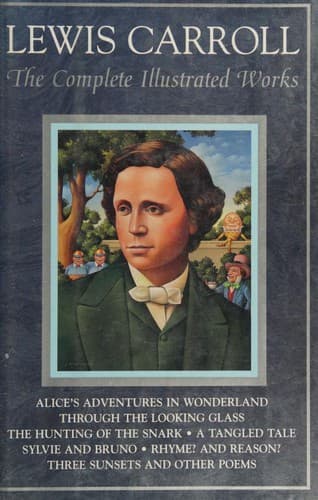
Sylvie and Bruno Concluded (Illustrated)Carroll, Lewis
Science
Sylvie and Bruno Concluded (Illustrated)
Carroll, Lewis
Fantasy fiction
“I think there _is_,” said Arthur: “but it seems to me to arise from a
Law of God—that every one shall do as much as he can to help others—and
not from any _rights_, on the part of the community, to exact labour as
an equivalent for food that has already been fairly earned.”
“I suppose the _second_ form of the problem is where the ‘idle mouths’
possess _money_ instead of _material_ wealth?”
“Yes,” replied Arthur: “and I think the simplest case is that of
_paper_-money. _Gold_ is itself a form of material wealth; but a
bank-note is merely a _promise_ to hand over so much _material_ wealth
when called upon to do so. The father of these four ‘idle mouths,’ had
done (let us say) five thousand pounds’ worth of useful work for the
community. In return for this, the community had given him what amounted
to a written promise to hand over, whenever called upon to do so, five
thousand pounds’ worth of food, &c. Then, if he only uses _one_ thousand
pounds’ worth himself, and leaves the rest of the notes to his children,
surely they have a full right to _present_ these written promises, and
to say ‘hand over the food, for which the equivalent labour has been
already done.’ Now I think _this_ case well worth stating, publicly and
clearly. I should like to drive it into the heads of those Socialists
who are priming our ignorant paupers with such sentiments as ‘Look at
them bloated haristocrats! Doing not a stroke o’ work for theirselves,
and living on the sweat of _our_ brows!’ I should like to _force_ them
to see that the _money_, which those ‘haristocrats’ are spending,
represents so much labour _already done_ for the community, and whose
equivalent, in _material_ wealth, is _due from the community_.”
“Might not the Socialists reply ‘Much of this money does not represent
_honest_ labour _at all_. If you could trace it back, from owner to
owner, though you might begin with several legitimate steps, such as
gift, or bequeathing by will, or ‘value received,’ you would soon reach
an owner who had no moral right to it, but had got it by fraud or other
crimes; and of course his successors in the line would have no better
right to it than _he_ had.”
“No doubt, no doubt,” Arthur replied. “But surely that involves the
logical fallacy of _proving too much_? It is _quite_ as applicable to
_material_ wealth, as it is to _money_. If we once begin to go back
beyond the fact that the _present_ owner of certain property came by it
honestly, and to ask whether any previous owner, in past ages, got it by
fraud, would _any_ property be secure?”
After a minute’s thought, I felt obliged to admit the truth of this.
Public-domain text, read in full here on John Shaqi.
Reviews
Reviews
No reviews yet
Be the first to share your thoughts on this work.
Join the Discussion
Join the discussion
Sign in to leave a comment or review.
Sign InorCreate an account