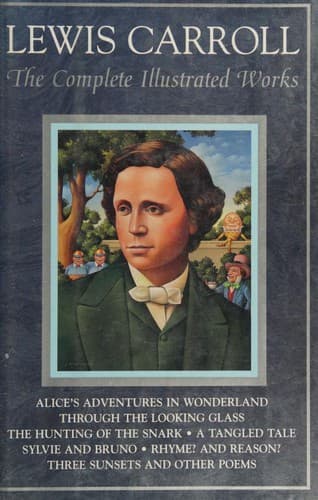
Sylvie and Bruno Concluded (Illustrated)Carroll, Lewis
Science
Sylvie and Bruno Concluded (Illustrated)
Carroll, Lewis
Fantasy fiction
“My general conclusion,” Arthur continued, “from the mere standpoint of
human _rights_, man against man, was this—that if some wealthy ‘idle
mouth,’ who has come by his money in a lawful way, even though not one
atom of the labour it represents has been his own doing, chooses to
spend it on his own needs, without contributing any labour to the
community from whom he buys his food and clothes, that community has no
_right_ to interfere with him. But it’s quite another thing, when we
come to consider the _divine_ law. Measured by _that_ standard, such a
man is undoubtedly doing wrong, if he fails to use, for the good of
those in need, the strength or the skill, that God has given him. That
strength and skill do _not_ belong to the community, to be paid to
_them_ as a _debt_: they do _not_ belong to the man _himself_, to be
used for his _own_ enjoyment: they _do_ belong to God, to be used
according to _His_ will; and we are not left in doubt as to what that
will is. ‘_Do good, and lend, hoping for nothing again._’”
“Anyhow,” I said, “an ‘idle mouth’ very often gives away a great deal in
charity.”
“In _so-called_ ‘charity,’” he corrected me. “Excuse me if I seem to
speak _un_charitably. I would not dream of _applying_ the term to any
_individual_. But I would say, _generally_, that a man who gratifies
every fancy that occurs to him—denying himself in _nothing_—and merely
gives to the poor some part, or even _all_, of his _superfluous_ wealth,
is only deceiving himself if he calls it _charity_.”
“But, even in giving away _superfluous_ wealth, he _may_ be denying
himself the miser’s pleasure in hoarding?”
“I grant you that, gladly,” said Arthur. “Given that he _has_ that
morbid craving, he is doing a good deed in restraining it.”
“But, even in spending on _himself_,” I persisted, “our typical rich man
often does good, by employing people who would otherwise be out of work:
and that is often better than pauperising them by _giving_ the money.”
“I’m glad you’ve said that!” said Arthur. “I would not like to quit the
subject without exposing the _two_ fallacies of that statement—which
have gone so long uncontradicted that Society now accepts it as an
axiom!”
“What are they?” I said. “I don’t even see _one_, myself.”
“One is merely the fallacy of _ambiguity_—the assumption that ‘_doing
good_’ (that is, benefiting somebody) is necessarily _a good thing to
do_ (that is, a _right_ thing). The other is the assumption that, if one
of two specified acts is _better_ than another, it is necessarily a
_good_ act in itself. I should like to call this the fallacy of
_comparison_—meaning that it assumes that what is _comparatively_ good
is therefore _positively_ good.”
“Then what is _your_ test of a good act?”
Public-domain text, read in full here on John Shaqi.
Reviews
Reviews
No reviews yet
Be the first to share your thoughts on this work.
Join the Discussion
Join the discussion
Sign in to leave a comment or review.
Sign InorCreate an account