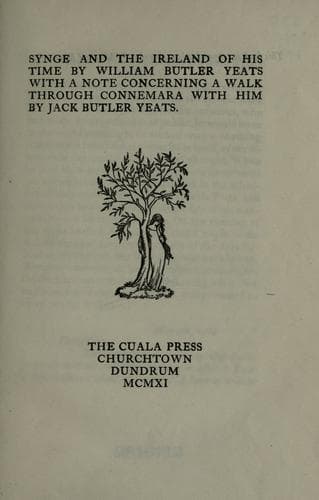
Synge and the Ireland of His TimeYeats, W. B. (William Butler)
General
Synge and the Ireland of His Time
Yeats, W. B. (William Butler)
Dramatists, Irish -- 20th century -- Biography; Synge, J. M. (John Millington), 1871-1909
Ireland for three generations has been like those churlish logicians.
Everything is argued over, everything has to take its trial before the
dull sense and the hasty judgment, and the character of the nation has
so changed that it hardly keeps but among country people, or where some
family tradition is still stubborn, those lineaments that made Borrow
cry out as he came from among the Irish monks, his friends and
entertainers for all his Spanish Bible scattering, 'Oh, Ireland, mother
of the bravest soldiers and of the most beautiful women!' It was as I
believe, to seek that old Ireland which took its mould from the
duellists and scholars of the 18th century and from generations older
still, that Synge returned again and again to Aran, to Kerry, and to
the wild Blaskets.
IX
'When I got up this morning' he writes, after he had been a long time
in Innismaan, 'I found that the people had gone to Mass and latched the
kitchen door from the outside, so that I could not open it to give
myself light.
'I sat for nearly an hour beside the fire with a curious feeling that I
should be quite alone in this little cottage. I am so used to sitting
here with the people that I have never felt the room before as a place
where any man might live and work by himself. After a while as I
waited, with just light enough from the chimney to let me see the
rafters and the greyness of the walls, I became indescribably mournful,
for I felt that this little corner on the face of the world, and the
people who live in it, have a peace and dignity from which we are shut
for ever.' This life, which he describes elsewhere as the most
primitive left in Europe, satisfied some necessity of his nature.
Before I met him in Paris he had wandered over much of Europe,
listening to stories in the Black Forest, making friends with servants
and with poor people, and this from an aesthetic interest, for he had
gathered no statistics, had no money to give, and cared nothing for the
wrongs of the poor, being content to pay for the pleasure of eye and
ear with a tune upon the fiddle. He did not love them the better
because they were poor and miserable, and it was only when he found
Innismaan and the Blaskets, where there is neither riches nor poverty,
neither what he calls 'the nullity of the rich' nor 'the squalor of the
poor' that his writing lost its old morbid brooding, that he found his
genius and his peace. Here were men and women who under the weight of
their necessity lived, as the artist lives, in the presence of death
and childhood, and the great affections and the orgiastic moment when
life outleaps its limits, and who, as it is always with those who have
refused or escaped the trivial and the temporary, had dignity and good
manners where manners mattered. Here above all was silence from all our
great orator took delight in, from formidable men, from moral
indignation, from the 'sciolist' who 'is never sad,' from all in modern
Public-domain text, read in full here on John Shaqi.
Reviews
Reviews
No reviews yet
Be the first to share your thoughts on this work.
Join the Discussion
Join the discussion
Sign in to leave a comment or review.
Sign InorCreate an account