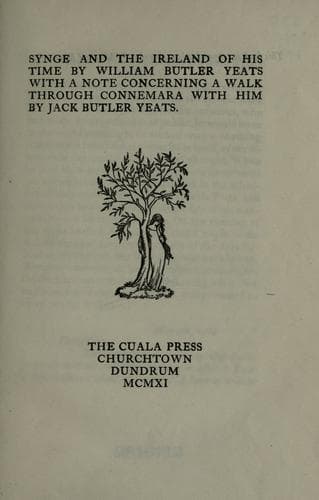
Synge and the Ireland of His TimeYeats, W. B. (William Butler)
General
Synge and the Ireland of His Time
Yeats, W. B. (William Butler)
Dramatists, Irish -- 20th century -- Biography; Synge, J. M. (John Millington), 1871-1909
world and mix into all he sees that flavour of extravagance, or of
humour, or of philosophy, that makes one understand that he
contemplates even his own death as if it were another's, and finds in
his own destiny but as it were a projection through a burning glass of
that general to men. There is in the creative joy an acceptance of what
life brings, because we have understood the beauty of what it brings,
or a hatred of death for what it takes away, which arouses within us,
through some sympathy perhaps with all other men, an energy so noble,
so powerful, that we laugh aloud and mock, in the terror or the
sweetness of our exaltation, at death and oblivion.
In no modern writer that has written of Irish life before him, except
it may be Miss Edgeworth in 'Castle Rackrent,' was there anything to
change a man's thought about the world or stir his moral nature, for
they but play with pictures, persons, and events, that whether well or
ill observed are but an amusement for the mind where it escapes from
meditation, a child's show that makes the fables of his art as
significant by contrast as some procession painted on an Egyptian wall;
for in these fables, an intelligence, on which the tragedy of the world
had been thrust in so few years, that Life had no time to brew her
sleepy drug, has spoken of the moods that are the expression of its
wisdom. All minds that have a wisdom come of tragic reality seem morbid
to those that are accustomed to writers who have not faced reality at
all; just as the saints, with that Obscure Night of the Soul, which
fell so certainly that they numbered it among spiritual states, one
among other ascending steps, seem morbid to the rationalist and the
old-fashioned Protestant controversialist. The thought of journalists,
like that of the Irish novelists, is neither healthy nor unhealthy, for
it has not risen to that state where either is possible, nor should we
call it happy; for who would have sought happiness, if happiness were
not the supreme attainment of man, in heroic toils, in the cell of the
ascetic, or imagined it above the cheerful newspapers, above the clouds?
VIII
Not that Synge brought out of the struggle with himself any definite
philosophy, for philosophy in the common meaning of the word is created
out of an anxiety for sympathy or obedience, and he was that rare, that
distinguished, that most noble thing, which of all things still of the
world is nearest to being sufficient to itself, the pure artist. Sir
Philip Sidney complains of those who could hear 'sweet tunes' (by which
he understands could look upon his lady) and not be stirred to
'ravishing delight.'
'Or if they do delight therein, yet are so closed with wit,
As with sententious lips to set a title vain on it;
Oh let them hear these sacred tunes, and learn in Wonder's schools
To be, in things past bonds of wit, fools if they be not fools!'
Public-domain text, read in full here on John Shaqi.
Reviews
Reviews
No reviews yet
Be the first to share your thoughts on this work.
Join the Discussion
Join the discussion
Sign in to leave a comment or review.
Sign InorCreate an account