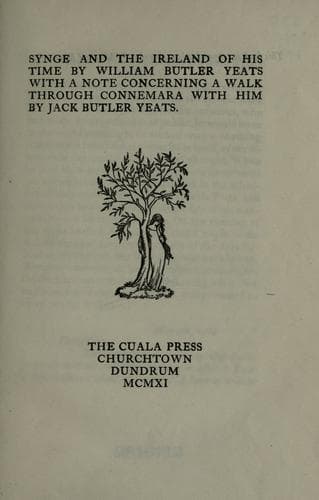
Synge and the Ireland of His TimeYeats, W. B. (William Butler)
General
Synge and the Ireland of His Time
Yeats, W. B. (William Butler)
Dramatists, Irish -- 20th century -- Biography; Synge, J. M. (John Millington), 1871-1909
He loves all that has edge, all that is salt in the mouth, all that is
rough to the hand, all that heightens the emotions by contest, all that
stings into life the sense of tragedy; and in this book, unlike the
plays where nearness to his audience moves him to mischief, he shows it
without thought of other taste than his. It is so constant, it is all
set out so simply, so naturally, that it suggests a correspondence
between a lasting mood of the soul and this life that shares the
harshness of rocks and wind. The food of the spiritual-minded is sweet,
an Indian scripture says, but passionate minds love bitter food. Yet he
is no indifferent observer, but is certainly kind and sympathetic to
all about him. When an old and ailing man, dreading the coming winter,
cries at his leaving, not thinking to see him again; and he notices
that the old man's mitten has a hole in it where the palm is accustomed
to the stick, one knows that it is with eyes full of interested
affection as befits a simple man and not in the curiosity of study.
When he had left the Blaskets for the last time, he travelled with a
lame pensioner who had drifted there, why heaven knows, and one morning
having missed him from the inn where they were staying, he believed he
had gone back to the island and searched everywhere and questioned
everybody, till he understood of a sudden that he was jealous as though
the island were a woman.
The book seems dull if you read much at a time, as the later Kerry
essays do not, but nothing that he has written recalls so completely to
my senses the man as he was in daily life; and as I read, there are
moments when every line of his face, every inflection of his voice,
grows so clear in memory that I cannot realize that he is dead. He was
no nearer when we walked and talked than now while I read these
unarranged, unspeculating pages, wherein the only life he loved with
his whole heart reflects itself as in the still water of a pool.
Thought comes to him slowly, and only after long seemingly unmeditative
watching, and when it comes, (and he had the same character in matters
of business) it is spoken without hesitation and never changed. His
conversation was not an experimental thing, an instrument of research,
and this made him silent; while his essays recall events, on which one
feels that he pronounces no judgment even in the depth of his own mind,
because the labour of Life itself had not yet brought the philosophic
generalization, which was almost as much his object as the emotional
generalization of beauty. A mind that generalizes rapidly, continually
prevents the experience that would have made it feel and see deeply,
just as a man whose character is too complete in youth seldom grows
into any energy of moral beauty. Synge had indeed no obvious ideals, as
these are understood by young men, and even as I think disliked them,
for he once complained to me that our modern poetry was but the poetry
Public-domain text, read in full here on John Shaqi.
Reviews
Reviews
No reviews yet
Be the first to share your thoughts on this work.
Join the Discussion
Join the discussion
Sign in to leave a comment or review.
Sign InorCreate an account