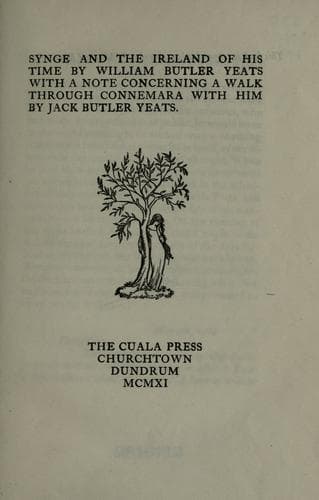
Synge and the Ireland of His TimeYeats, W. B. (William Butler)
General
Synge and the Ireland of His Time
Yeats, W. B. (William Butler)
Dramatists, Irish -- 20th century -- Biography; Synge, J. M. (John Millington), 1871-1909
'of the lyrical boy,' and this lack makes his art have a strange
wildness and coldness, as of a man born in some far-off spacious land
and time.
XI
There are artists like Byron, like Goethe, like Shelley, who have
impressive personalities, active wills and all their faculties at the
service of the will; but he belonged to those who like Wordsworth, like
Coleridge, like Goldsmith, like Keats, have little personality, so far
as the casual eye can see, little personal will, but fiery and brooding
imagination. I cannot imagine him anxious to impress, or convince in
any company, or saying more than was sufficient to keep the talk
circling. Such men have the advantage that all they write is a part of
knowledge, but they are powerless before events and have often but one
visible strength, the strength to reject from life and thought all that
would mar their work, or deafen them in the doing of it; and only this
so long as it is a passive act. If Synge had married young or taken
some profession, I doubt if he would have written books or been greatly
interested in a movement like ours; but he refused various
opportunities of making money in what must have been an almost
unconscious preparation. He had no life outside his imagination, little
interest in anything that was not its chosen subject. He hardly seemed
aware of the existence of other writers. I never knew if he cared for
work of mine, and do not remember that I had from him even a
conventional compliment, and yet he had the most perfect modesty and
simplicity in daily intercourse, self-assertion was impossible to him.
On the other hand, he was useless amidst sudden events. He was much
shaken by the Playboy riot; on the first night confused and excited,
knowing not what to do, and ill before many days, but it made no
difference in his work. He neither exaggerated out of defiance nor
softened out of timidity. He wrote on as if nothing had happened,
altering 'The Tinker's Wedding' to a more unpopular form, but writing a
beautiful serene 'Deirdre,' with, for the first time since his 'Riders
to the Sea,' no touch of sarcasm or defiance. Misfortune shook his
physical nature while it left his intellect and his moral nature
untroubled. The external self, the mask, the persona was a shadow,
character was all.
XII
He was a drifting silent man full of hidden passion, and loved wild
islands, because there, set out in the light of day, he saw what lay
hidden in himself. There is passage after passage in which he dwells
upon some moment of excitement. He describes the shipping of pigs at
Kilronan on the North Island for the English market: 'when the steamer
was getting near, the whole drove was moved down upon the slip and the
curraghs were carried out close to the sea. Then each beast was caught
in its turn and thrown on its side, while its legs were hitched
together in a single knot, with a tag of rope remaining, by which it
could be carried.
Public-domain text, read in full here on John Shaqi.
Reviews
Reviews
No reviews yet
Be the first to share your thoughts on this work.
Join the Discussion
Join the discussion
Sign in to leave a comment or review.
Sign InorCreate an account