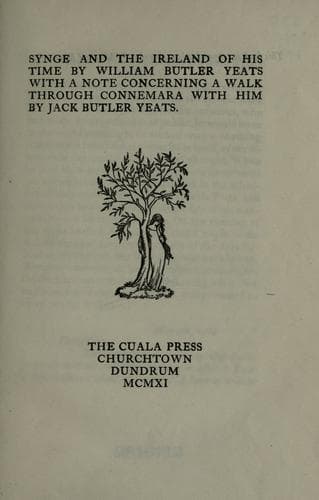
Synge and the Ireland of His TimeYeats, W. B. (William Butler)
General
Synge and the Ireland of His Time
Yeats, W. B. (William Butler)
Dramatists, Irish -- 20th century -- Biography; Synge, J. M. (John Millington), 1871-1909
Synge was delighted with the narrow paths made of sods of grass
alongside the newly-metalled roads, because he thought they had been
put there to make soft going for the bare feet of little children.
Children knew, I think, that he wished them well. In Bellmullet on
Saint John's eve, when we stood in the market square watching the
fire-play, flaming sods of turf soaked in paraffine, hurled to the sky
and caught and skied again, and burning snakes of hay-rope, I remember
a little girl in the crowd, in an ecstasy of pleasure and dread,
clutched Synge by the hand and stood close in his shadow until the
fiery games were done.
His knowledge of Gaelic was a great assistance to him in talking to the
people. I remember him holding a great conversation in Irish and
English with an innkeeper's wife in a Mayo inn. She had lived in
America in Lincoln's day. She told us what living cost in America then,
and of her life there; her little old husband sitting by and putting in
an odd word. By the way, the husband was a wonderful gentle-mannered
man, for we had luncheon in his house of biscuits and porter, and
rested there an hour, waiting for a heavy shower to blow away; and when
we said good-bye and our feet were actually on the road, Synge said,
'Did we pay for what we had?' So I called back to the innkeeper, 'Did
we pay you?' and he said quietly, 'Not yet sir.'
Synge was always delighted to hear and remember any good phrase. I
remember his delight at the words of a local politician who told us how
he became a Nationalist. 'I was,' he said plucking a book from the
mantlepiece (I remember the book--it was 'Paul and Virginia') and
clasping it to his breast--'I was but a little child with my little
book going to school, and by the house there I saw the agent. He took
the unfortunate tenant and thrun him in the road, and I saw the man's
wife come out crying and the agent's wife thrun her in the channel, and
when I saw that, though I was but a child, I swore I'd be a
Nationalist. I swore by heaven, and I swore by hell and all the rivers
that run through them.'
Synge must have read a great deal at one time, but he was not a man you
would see often with a book in his hand; he would sooner talk, or
rather listen to talk--almost anyone's talk.
Synge was always ready to go anywhere with one, and when there to enjoy
what came. He went with me to see an ordinary melodrama at the Queen's
Theatre, Dublin, and he delighted to see how the members of the company
could by the vehemence of their movements and the resources of their
voices hold your attention on a play where everything was commonplace.
He enjoyed seeing the contrite villain of the piece come up from the
bottom of the gulch, hurled there by the adventuress, and flash his
sweating blood-stained face up against the footlights; and, though he
told us he had but a few short moments to live, roar his contrition
with the voice of a bull.
Public-domain text, read in full here on John Shaqi.
Reviews
Reviews
No reviews yet
Be the first to share your thoughts on this work.
Join the Discussion
Join the discussion
Sign in to leave a comment or review.
Sign InorCreate an account