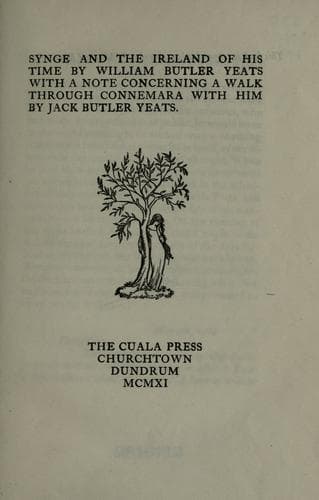
Synge and the Ireland of His TimeYeats, W. B. (William Butler)
General
Synge and the Ireland of His Time
Yeats, W. B. (William Butler)
Dramatists, Irish -- 20th century -- Biography; Synge, J. M. (John Millington), 1871-1909
like his, although it does not command--indeed because it does not--may
lie the roots of far-branching events. Only that which does not teach,
which does not cry out, which does not persuade, which does not
condescend, which does not explain is irresistible. It is made by men
who expressed themselves to the full, and it works through the best
minds; whereas the external and picturesque and declamatory writers,
that they may create kilts and bagpipes and newspapers and guide-books,
leave the best minds empty, and in Ireland and Scotland England runs
into the hole. It has no array of arguments and maxims, because the
great and the simple (and the Muses have never known which of the two
most pleases them) need their deliberate thought for the day's work,
and yet will do it worse if they have not grown into or found about
them, most perhaps in the minds of women, the nobleness of emotion,
associated with the scenery and events of their country, by those great
poets, who have dreamed it in solitude, and who to this day in Europe
are creating indestructible spiritual races, like those religion has
created in the East.
W. B. Yeats.
September 14th. 1910.
* * * * *
WITH SYNGE IN CONNEMARA
I had often spent a day walking with John Synge, but a year or two ago
I travelled for a month alone through the west of Ireland with him. He
was the best companion for a roadway any one could have, always ready
and always the same; a bold walker, up hill and down dale, in the hot
sun and the pelting rain. I remember a deluge on the Erris Peninsula,
where we lay among the sand hills and at his suggestion heaped sand
upon ourselves to try and keep dry.
When we started on our journey, as the train steamed out of Dublin,
Synge said: 'Now the elder of us two should be in command on this
trip.' So we compared notes and I found that he was two months older
than myself. So he was boss and whenever it was a question whether we
should take the road to the west or the road to the south, it was Synge
who finally decided.
Synge was fond of little children and animals. I remember how glad he
was to stop and lean on a wall in Gorumna and watch a woman in afield
shearing a sheep. It was an old sheep and must have often been sheared
before by the same hand, for the woman hardly held it; she just knelt
beside it and snipped away. I remember the sheep raised its lean old
head to look at the stranger, and the woman just put her hand on its
cheek and gently pressed its head down on the grass again.
Public-domain text, read in full here on John Shaqi.
Reviews
Reviews
No reviews yet
Be the first to share your thoughts on this work.
Join the Discussion
Join the discussion
Sign in to leave a comment or review.
Sign InorCreate an account