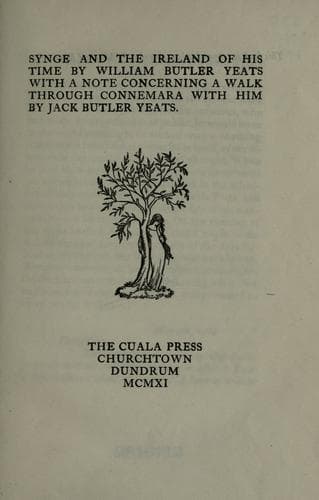
Synge and the Ireland of His TimeYeats, W. B. (William Butler)
General
Synge and the Ireland of His Time
Yeats, W. B. (William Butler)
Dramatists, Irish -- 20th century -- Biography; Synge, J. M. (John Millington), 1871-1909
A patriotic journalism which had seen in Synge's capricious imagination
the enemy of all it would have young men believe, had for years
prepared for this hour, by that which is at once the greatest and most
ignoble power of journalism, the art of repeating a name again and
again with some ridiculous or evil association. The preparation had
begun after the first performance of 'The Shadow of the Glen,' Synge's
first play, with an assertion made in ignorance but repeated in
dishonesty, that he had taken his fable and his characters, not from
his own mind nor that profound knowledge of cot and curragh he was
admitted to possess, but 'from a writer of the Roman decadence.' Some
spontaneous dislike had been but natural, for genius like his can but
slowly, amid what it has of harsh and strange, set forth the nobility
of its beauty, and the depth of its compassion; but the frenzy that
would have silenced his master-work was, like most violent things
artificial, the defence of virtue by those that have but little, which
is the pomp and gallantry of journalism and its right to govern the
world.
As I stood there watching, knowing well that I saw the dissolution of a
school of patriotism that held sway over my youth, Synge came and stood
beside me, and said, 'A young doctor has just told me that he can
hardly keep himself from jumping on to a seat, and pointing out in that
howling mob those whom he is treating for venereal disease.'
II
Thomas Davis, whose life had the moral simplicity which can give to
actions the lasting influence that style alone can give to words, had
understood that a country which has no national institutions must show
its young men images for the affections, although they be but diagrams
of what it should be or may be. He and his school imagined the Soldier,
the Orator, the Patriot, the Poet, the Chieftain, and above all the
Peasant; and these, as celebrated in essay and songs and stories,
possessed so many virtues that no matter how England, who as Mitchell
said 'had the ear of the world,' might slander us, Ireland, even though
she could not come at the world's other ear, might go her way
unabashed. But ideas and images which have to be understood and loved
by large numbers of people, must appeal to no rich personal experience,
no patience of study, no delicacy of sense; and if at rare moments some
'Memory of the Dead' can take its strength from one; at all other
moments manner and matter will be rhetorical, conventional,
sentimental; and language, because it is carried beyond life
perpetually, will be as wasted as the thought, with unmeaning
pedantries and silences, and a dread of all that has salt and savour.
After a while, in a land that has given itself to agitation over-much,
abstract thoughts are raised up between men's minds and Nature, who
never does the same thing twice, or makes one man like another, till
minds, whose patriotism is perhaps great enough to carry them to the
Public-domain text, read in full here on John Shaqi.
Reviews
Reviews
No reviews yet
Be the first to share your thoughts on this work.
Join the Discussion
Join the discussion
Sign in to leave a comment or review.
Sign InorCreate an account