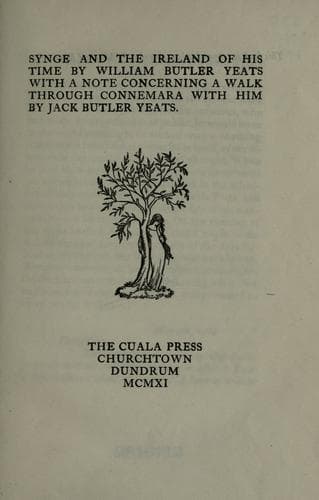
Synge and the Ireland of His TimeYeats, W. B. (William Butler)
General
Synge and the Ireland of His Time
Yeats, W. B. (William Butler)
Dramatists, Irish -- 20th century -- Biography; Synge, J. M. (John Millington), 1871-1909
I admired though we were always quarrelling on some matter, J.F.
Taylor, the orator, who died just before the first controversy over
these plays. It often seemed to me that when he spoke Ireland herself
had spoken, one got that sense of surprise that comes when a man has
said what is unforeseen because it is far from the common thought, and
yet obvious because when it has been spoken, the gate of the mind seems
suddenly to roll back and reveal forgotten sights and let loose lost
passions. I have never heard him speak except in some Irish literary or
political society, but there at any rate, as in conversation, I found a
man whose life was a ceaseless reverie over the religious and political
history of Ireland. He saw himself pleading for his country before an
invisible jury, perhaps of the great dead, against traitors at home and
enemies abroad, and a sort of frenzy in his voice and the moral
elevation of his thoughts gave him for the moment style and music. One
asked oneself again and again, 'Why is not this man an artist, a man of
genius, a creator of some kind?' The other day under the influence of
memory, I read through his one book, a life of Owen Roe O'Neill, and
found there no sentence detachable from its context because of wisdom
or beauty. Everything was argued from a premise; and wisdom, and style,
whether in life or letters come from the presence of what is
self-evident, from that which requires but statement, from what Blake
called 'naked beauty displayed.' The sense of what was unforeseen and
obvious, the rolling backward of the gates had gone with the living
voice, with the nobility of will that made one understand what he saw
and felt in what was now but argument and logic. I found myself in the
presence of a mind like some noisy and powerful machine, of thought
that was no part of wisdom but the apologetic of a moment, a woven
thing, no intricacy of leaf and twig, of words with no more of salt and
of savour than those of a Jesuit professor of literature, or of any
other who does not know that there is no lasting writing which does not
define the quality, or carry the substance of some pleasure. How can
one, if one's mind be full of abstractions and images created not for
their own sake but for the sake of party, even if there were still the
need, find words that delight the ear, make pictures to the mind's eye,
discover thoughts that tighten the muscles, or quiver and tingle in the
flesh, and stand like St. Michael with the trumpet that calls the body
to resurrection?
IV
Public-domain text, read in full here on John Shaqi.
Reviews
Reviews
No reviews yet
Be the first to share your thoughts on this work.
Join the Discussion
Join the discussion
Sign in to leave a comment or review.
Sign InorCreate an account