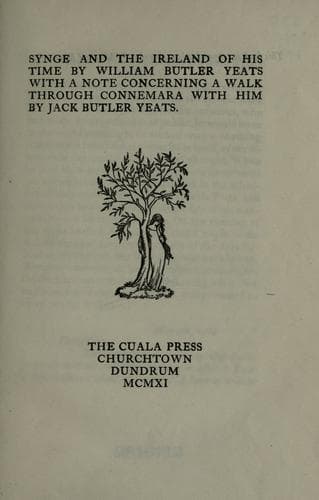
Synge and the Ireland of His TimeYeats, W. B. (William Butler)
General
Synge and the Ireland of His Time
Yeats, W. B. (William Butler)
Dramatists, Irish -- 20th century -- Biography; Synge, J. M. (John Millington), 1871-1909
Young Ireland had taught a study of our history with the glory of
Ireland for event, and this for lack, when less than Taylor studied, of
comparison with that of other countries wrecked the historical
instinct. An old man with an academic appointment, who was a leader in
the attack upon Synge, sees in the 11th century romance of Deirdre a
re-telling of the first five act tragedy outside the classic languages,
and this tragedy from his description of it was certainly written on
the Elizabethan model; while an allusion to a copper boat, a marvel of
magic like Cinderella's slipper, persuades him that the ancient Irish
had forestalled the modern dockyards in the making of metal ships. The
man who doubted, let us say, our fabulous ancient kings running up to
Adam, or found but mythology in some old tale, was as hated as if he
had doubted the authority of Scripture. Above all no man was so
ignorant, that he had not by rote familiar arguments and statistics to
drive away amid familiar applause, all those had they but found strange
truth in the world or in their mind, whose knowledge has passed out of
memory and become an instinct of hand or eye. There was no literature,
for literature is a child of experience always, of knowledge never; and
the nation itself, instead of being a dumb struggling thought seeking a
mouth to utter it or hand to show it, a teeming delight that would
re-create the world, had become, at best, a subject of knowledge.
V
Taylor always spoke with confidence though he was no determined man,
being easily flattered or jostled from his way; and this, putting as it
were his fiery heart into his mouth made him formidable. And I have
noticed that all those who speak the thoughts of many, speak
confidently, while those who speak their own thoughts are hesitating
and timid, as though they spoke out of a mind and body grown sensitive
to the edge of bewilderment among many impressions. They speak to us
that we may give them certainty, by seeing what they have seen; and so
it is, that enlargement of experience does not come from those
oratorical thinkers, or from those decisive rhythms that move large
numbers of men, but from writers that seem by contrast as feminine as
the soul when it explores in Blake's picture the recesses of the grave,
carrying its faint lamp trembling and astonished; or as the Muses who
are never pictured as one-breasted amazons, but as women needing
protection. Indeed, all art which appeals to individual man and awaits
the confirmation of his senses and his reveries, seems when arrayed
against the moral zeal, the confident logic, the ordered proof of
journalism, a trifling, impertinent, vexatious thing, a tumbler who has
unrolled his carpet in the way of a marching army.
VI
Public-domain text, read in full here on John Shaqi.
Reviews
Reviews
No reviews yet
Be the first to share your thoughts on this work.
Join the Discussion
Join the discussion
Sign in to leave a comment or review.
Sign InorCreate an account