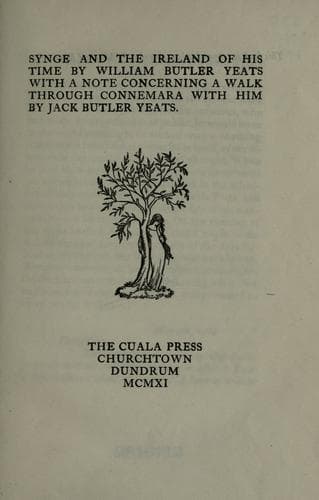
Synge and the Ireland of His TimeYeats, W. B. (William Butler)
General
Synge and the Ireland of His Time
Yeats, W. B. (William Butler)
Dramatists, Irish -- 20th century -- Biography; Synge, J. M. (John Millington), 1871-1909
I had spoken of a German municipal theatre as my model, and he said
that the municipal theatres all over Europe gave fine performances of
old classics but did not create (he disliked modern drama for its
sterility of speech, and perhaps ignored it) and that we would create
nothing if we did not give all our thoughts to Ireland. Yet in Ireland
he loved only what was wild in its people, and in 'the grey and wintry
sides of many glens.' All the rest, all that one reasoned over, fought
for, read of in leading articles, all that came from education, all
that came down from Young Ireland--though for this he had not lacked a
little sympathy--first wakened in him perhaps that irony which runs
through all he wrote, but once awakened, he made it turn its face upon
the whole of life. The women quarrelling in the cave would not have
amused him, if something in his nature had not looked out on most
disputes, even those wherein he himself took sides, with a mischievous
wisdom. He told me once that when he lived in some peasant's house, he
tried to make those about him forget that he was there, and it is
certain that he was silent in any crowded room. It is possible that low
vitality helped him to be observant and contemplative, and made him
dislike, even in solitude, those thoughts which unite us to others,
much as we all dislike, when fatigue or illness has sharpened the
nerves, hoardings covered with advertisements, the fronts of big
theatres, big London hotels, and all architecture which has been made
to impress the crowd. What blindness did for Homer, lameness for
Hephaestus, asceticism for any saint you will, bad health did for him
by making him ask no more of life than that it should keep him living,
and above all perhaps by concentrating his imagination upon one
thought, health itself. I think that all noble things are the result of
warfare; great nations and classes, of warfare in the visible world,
great poetry and philosophy, of invisible warfare, the division of a
mind within itself, a victory, the sacrifice of a man to himself. I am
certain that my friend's noble art, so full of passion and heroic
beauty, is the victory of a man who in poverty and sickness created
from the delight of expression, and in the contemplation that is born
of the minute and delicate arrangement of images, happiness, and health
of mind. Some early poems have a morbid melancholy, and he himself
spoke of early work he had destroyed as morbid, for as yet the
craftmanship was not fine enough to bring the artist's joy which is of
one substance with that of sanctity. In one poem he waits at some
street corner for a friend, a woman perhaps, and while he waits and
gradually understands that nobody is coming, sees two funerals and
shivers at the future; and in another written on his 25th birthday, he
wonders if the 25 years to come shall be as evil as those gone by.
Later on, he can see himself as but a part of the spectacle of the
Public-domain text, read in full here on John Shaqi.
Reviews
Reviews
No reviews yet
Be the first to share your thoughts on this work.
Join the Discussion
Join the discussion
Sign in to leave a comment or review.
Sign InorCreate an account