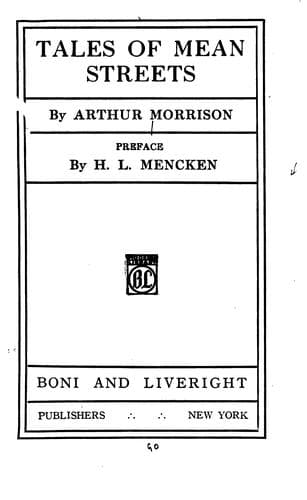
East End (London, England) -- Fiction; London (England) -- Social life and customs -- Fiction
One of the square holes in this street--one of the single, ground-floor
holes--is found, on individual examination, to differ from the others.
There has been an attempt to make it into a shop-window. Half a dozen
candles, a few sickly sugar-sticks, certain shrivelled bloaters, some
bootlaces, and a bundle or two of firewood compose a stock which at
night is sometimes lighted by a little paraffine lamp in a tin sconce,
and sometimes by a candle. A widow lives here--a gaunt, bony widow, with
sunken, red eyes. She has other sources of income than the candles and
the bootlaces: she washes and chars all day, and she sews cheap shirts
at night. Two "young men lodgers," moreover, sleep upstairs, and the
children sleep in the back room; she herself is supposed not to sleep at
all. The policeman does not knock here in the morning--the widow wakes
the lodgers herself; and nobody in the street behind ever looks out of
window before going to bed, no matter how late, without seeing a light
in the widow's room where she plies her needle. She is a quiet woman,
who speaks little with her neighbors, having other things to do: a woman
of pronounced character, to whom it would be unadvisable--even
dangerous--to offer coals or blankets. Hers was the strongest contempt
for the helpless woman who sang: a contempt whose added bitterness
might be traced to its source. For when the singing woman was marketing,
from which door of the pawnshop had she twice met the widow coming
forth?
This is not a dirty street, taken as a whole. The widow's house is one
of the cleanest, and the widow's children match the house. The one house
cleaner than the widow's is ruled by a despotic Scotchwoman, who drives
every hawker off her whitened step, and rubs her door handle if a hand
have rested on it. The Scotchwoman has made several attempts to
accommodate "young men lodgers," but they have ended in shrill rows.
There is no house without children in this street, and the number of
them grows ever and ever greater. Nine-tenths of the doctor's visits are
on this account alone, and his appearances are the chief matter of such
conversation as the women make across the fences. One after another the
little strangers come, to live through lives as flat and colorless as
the day's life in this street. Existence dawns, and the
doctor-watchman's door knock resounds along the row of rectangular
holes. Then a muffled cry announces that a small new being has come to
trudge and sweat its way in the appointed groove. Later, the trotting of
little feet and the school; the midday play hour, when love peeps even
into this street; after that more trotting of little feet--strange
little feet, new little feet--and the scrubbing, and the squalling, and
the barren flower-pot; the end of the sooty day's work; the last
home-coming; nightfall; sleep.
Public-domain text, read in full here on John Shaqi.
Reviews
Reviews
No reviews yet
Be the first to share your thoughts on this work.
Join the Discussion
Join the discussion
Sign in to leave a comment or review.
Sign InorCreate an account