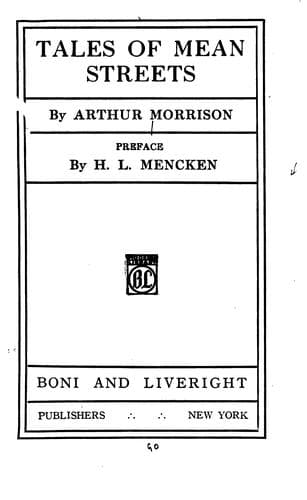
East End (London, England) -- Fiction; London (England) -- Social life and customs -- Fiction
When love's light falls into some corner of the street, it falls at an
early hour of this mean life, and is itself but a dusty ray. It falls
early, because it is the sole bright thing which the street sees, and is
watched for and counted on. Lads and lasses, awkwardly arm in arm, go
pacing up and down this street, before the natural interest in marbles
and doll's houses would have left them in a brighter place. They are
"keeping company"; the manner of which proceeding is indigenous--is a
custom native to the place. The young people first "walk out" in pairs.
There is no exchange of promises, no troth-plight, no engagement, no
love-talk. They patrol the street side by side, usually in silence,
sometimes with fatuous chatter. There are no dances, no tennis, no
water-parties, no picnics to bring them together: so they must walk out,
or be unacquainted. If two of them grow dissatisfied with each other's
company, nothing is easier than to separate and walk out with somebody
else. When by these means each has found a fit mate (or thinks so), a
ring is bought, and the odd association becomes a regular engagement;
but this is not until the walking out has endured for many months. The
two stages of courtship are spoken of indiscriminately as "keeping
company," but a very careful distinction is drawn between them by the
parties concerned. Nevertheless, in the walking out period it would be
almost as great a breach of faith for either to walk out with more than
one, as it would be if the full engagement had been made. And
love-making in this street is a dreary thing, when one thinks of
love-making in other places. It begins--and it ends--too soon.
Nobody from this street goes to the theatre. That would mean a long
journey, and it would cost money which might buy bread and beer and
boots. For those, too, who wear black Sunday suits it would be sinful.
Nobody reads poetry or romance. The very words are foreign. A Sunday
paper in some few houses provides such reading as this street is
disposed to achieve. Now and again a penny novel has been found among
the private treasures of a growing daughter, and has been wrathfully
confiscated. For the air of this street is unfavorable to the ideal.
Yet there are aspirations. There has lately come into the street a young
man lodger who belongs to a Mutual Improvement Society. Membership in
this society is regarded as a sort of learned degree, and at its
meetings debates are held and papers smugly read by lamentably
self-satisfied young men lodgers, whose only preparation for debating
and writing is a fathomless ignorance. For ignorance is the inevitable
portion of dwellers here: seeing nothing, reading nothing, and
considering nothing.
Public-domain text, read in full here on John Shaqi.
Reviews
Reviews
No reviews yet
Be the first to share your thoughts on this work.
Join the Discussion
Join the discussion
Sign in to leave a comment or review.
Sign InorCreate an account