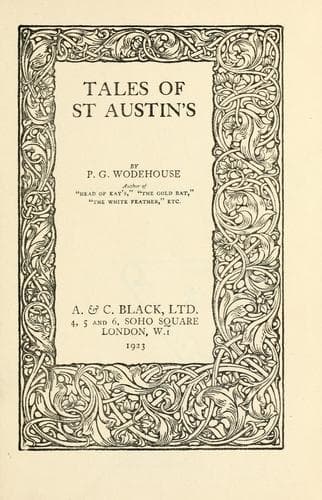
Tales of St. Austin'sWodehouse, P. G. (Pelham Grenville)
General
Tales of St. Austin's
Wodehouse, P. G. (Pelham Grenville)
Humorous stories; Schools -- Fiction
'Well, so he did, didn't he?'
'No, he didn't. The Old Man set it himself,' said Bradshaw, gloomily.
[6]
A SHOCKING AFFAIR
The Bradshaw who appears in the following tale is the same youth who
figures as the hero--or villain, label him as you like--of the
preceding equally veracious narrative. I mention this because I should
not care for you to go away with the idea that a waistcoat marked with
the name of Bradshaw must of necessity cover a scheming heart. It may,
however, be noticed that a good many members of the Bradshaw family
possess a keen and rather sinister sense of the humorous, inherited
doubtless from their great ancestor, the dry wag who wrote that
monument of quiet drollery, _Bradshaw's Railway Guide_. So with
the hero of my story.
Frederick Wackerbath Bradshaw was, as I have pointed out, my
contemporary at St Austin's. We were in the same House, and together we
sported on the green--and elsewhere--and did our best to turn the
majority of the staff of masters into confirmed pessimists, they in the
meantime endeavouring to do the same by us with every weapon that lay
to their hand. And the worst of these weapons were the end-of-term
examination papers. Mellish was our form-master, and once a term a
demon entered into Mellish. He brooded silently apart from the madding
crowd. He wandered through dry places seeking rest, and at intervals he
would smile evilly, and jot down a note on the back of an envelope.
These notes, collected and printed closely on the vilest paper, made up
the examination questions.
Our form read two authors a term, one Latin and one Greek. It was the
Greek that we feared most. Mellish had a sort of genius for picking out
absolutely untranslatable passages, and desiring us (in print) to
render the same with full notes. This term the book had been
Thucydides, Book II, with regard to which I may echo the words of a
certain critic when called upon to give his candid opinion of a
friend's first novel, 'I dare not say what I think about that book.'
About a week before the commencement of the examinations, the ordinary
night-work used to cease, and we were supposed, during that week, to be
steadily going over the old ground and arming ourselves for the
approaching struggle. There were, I suppose, people who actually did do
this, but for my own part I always used to regard those seven days as a
blessed period of rest, set apart specially to enable me to keep
abreast of the light fiction of the day. And most of the form, so far
as I know, thought the same. It was only on the night before the
examination that one began to revise in real earnest. One's methods on
that night resolved themselves into sitting in a chair and wondering
where to begin. Just as one came to a decision, it was bedtime.
'Bradshaw,' I said, as I reached page 103 without having read a line,
'do you know any likely bits?'
Bradshaw looked up from his book. He was attempting to get a general
idea of Thucydides' style by reading _Pickwick_.
Public-domain text, read in full here on John Shaqi.
Reviews
Reviews
No reviews yet
Be the first to share your thoughts on this work.
Join the Discussion
Join the discussion
Sign in to leave a comment or review.
Sign InorCreate an account