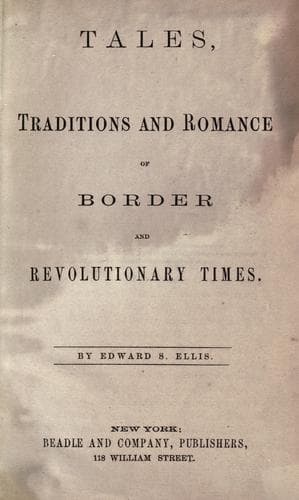
Tales, Traditions and Romance of Border and Revolutionary TimesEllis, Edward Sylvester
History
Tales, Traditions and Romance of Border and Revolutionary Times
Ellis, Edward Sylvester
Frontier and pioneer life -- United States -- Anecdotes; United States -- History -- Revolution, 1775-1783 -- Anecdotes
In those days Indian fashions prevailed, in some measure, with the
whites, at least with rangers. Brady was desirous of seeing the Indian
he had shot, and the officer in command of Fort McIntosh gave him some
men in addition to his own, and he returned to search for the body. The
place where lie had fallen was discovered, but nothing more. No pains
were spared to search, but the body was not found. They were about to
leave the place, when the yell of a _pet_ Indian, that came with them
from the fort, called them to a little glade, where the grave was
discovered. The Indians had interred their dead brother there, carefully
replacing the sod in the neatest manner. They had also cut brushes and
stuck them into the ground, but the brushes had withered, and instead of
concealing the grave, they led to the discovery.
He was buried about two feet deep, with all his implements of war about
him.
All his savage jewelry, his arms and ammunition were taken from him, and
the scalp from his head, and then they left him, thus stripped, alone in
his grave. It is painful to think of such things being done by American
soldiers, but we cannot now know all the excusing circumstances that may
have existed at the time. Perhaps the husband of this woman, the father
of this child, was thus butchered before his wife and children; and the
younger members of the family, unable to bear the fatigues of traveling,
had their brains dashed out on the threshold. Such things were common,
and a spirit of revenge was deeply seated in the breasts of the people
of the frontiers. Captain Brady's own family had heavily felt the
merciless tomahawk. His brave and honored father, and a beloved brother,
had been treacherously slain by the Indians, and he had vowed vengeance.
After refreshing himself and men, they went up to Pittsburg by water,
where they were received with military honors. Minute guns were fired
from the time Brady came in sight until he landed.
The Chickasaw Indians had returned to Pittsburg, and reported that the
Captain and his party had been cut off near Sandusky town by the
Indians. When General Broadhead heard this, he said Brady was an
aspiring young man, and had solicited the command. But on Brady's
arrival in Pittsburg, the General acknowledged that the Captain had
accepted the command with much diffidence.
A few days after Brady had left Sandusky with his squaw prisoners,
keeping a sharp look-out in expectation of being pursued, and taking
every precaution to avoid pursuit, such as keeping on the dryest ridges,
and walking on logs whenever they suited his course, he found he was
followed by Indians. His practised eye would occasionally discover in
the distance, an Indian hopping to or from a tree, or other screen, and
advancing on his trail. After being satisfied of the fact, he stated it
to his men, and told them no Indian could thus pursue him, after the
precautions he had taken, without a dog on his track.
Public-domain text, read in full here on John Shaqi.
Reviews
Reviews
No reviews yet
Be the first to share your thoughts on this work.
Elsewhere in the archive
Join the Discussion
Join the discussion
Sign in to leave a comment or review.
Sign InorCreate an account