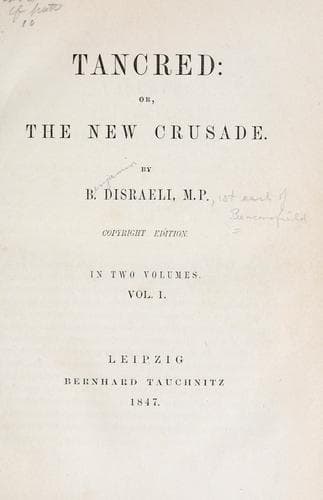
Tancred; Or, The New CrusadeDisraeli, Benjamin, Earl of Beaconsfield
ReligionJewish
Tancred; Or, The New Crusade
Disraeli, Benjamin, Earl of Beaconsfield
Christianity and other religions -- Judaism -- Fiction; Judaism -- Relations -- Christianity -- Fiction
His change to the palace of his uncle developed his native qualities,
which, under any accidents, could not perhaps have been long restrained,
but which the circumstances of the times brought to light, and matured
with a celerity peculiar to the East. The character of Fakredeen was
formed amid the excitement of the Syrian invasion and its stirring
consequences. At ten years of age he was initiated in all the mysteries
of political intrigue. His startling vivacity and the keen relish of his
infant intelligence for all the passionate interests of men amused and
sometimes delighted his uncle. Everything was spoken before him; he
lived in the centre of intrigues which were to shake thrones, and
perhaps to form them. He became habituated to the idea that everything
could be achieved by dexterity, and that there was no test of conduct
except success. To dissemble and to simulate; to conduct confidential
negotiations with contending powers and parties at the same time; to be
ready to adopt any opinion and to possess none; to fall into the public
humour of the moment, and to evade the impending catastrophe; to look
upon every man as a tool, and never do anything which had not a definite
though circuitous purpose; these were his political accomplishments;
and, while he recognised them as the best means of success, he found
in their exercise excitement and delight. To be the centre of a maze of
manoeuvres was his empyrean. He was never without a resource.
Stratagems came to him as naturally as fruit comes to a tree. He lived
in a labyrinth of plans, and he rejoiced to involve some one in the
perplexities which his magic touch could alone unravel. Fakredeen had
no principle of any kind; he had not a prejudice; a little superstition,
perhaps, like his postponing his journey because a hare crossed his
path. But, as for life and conduct in general, forming his opinions
from the great men of whom he had experience, princes, pashas, and some
others, and from the great transactions with which he was connected,
he was convinced that all was a matter of force or fraud. Fakredeen
preferred the latter, because it was more ingenious, and because he was
of a kind and passionate temperament, loving beauty and the beautiful,
apt to idealise everything, and of too exquisite a taste not to shrink
with horror from an unnecessary massacre.
Public-domain text, read in full here on John Shaqi.
Reviews
Reviews
No reviews yet
Be the first to share your thoughts on this work.
Elsewhere in the archive
Join the Discussion
Join the discussion
Sign in to leave a comment or review.
Sign InorCreate an account