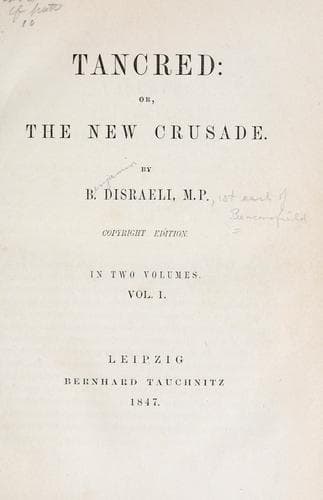
Tancred; Or, The New CrusadeDisraeli, Benjamin, Earl of Beaconsfield
ReligionJewish
Tancred; Or, The New Crusade
Disraeli, Benjamin, Earl of Beaconsfield
Christianity and other religions -- Judaism -- Fiction; Judaism -- Relations -- Christianity -- Fiction
Before the eventful day of which this, merry morn was the harbinger, the
arrivals of guests at the castle had been numerous and important. First
came the brother of the duchess, with his countess, and their fair
daughter the Lady Katherine, whose fate, unconsciously to herself, had
already been sealed by her noble relatives. She was destined to be the
third Katherine of Bellamont that her fortunate house had furnished to
these illustrious walls. Nor, if unaware of her high lot, did she seem
unworthy of it. Her mien was prophetic of the state assigned to her.
This was her first visit to Montacute since her early childhood, and she
had not encountered her cousin since their nursery days. The day after
them, Lord Eskdale came over from his principal seat in the contiguous
county, of which he was lord-lieutenant. He was the first cousin of the
duke, his father and the second Duke of Bellamont having married two
sisters, and of course intimately related to the duchess and her family.
Lord Eskdale exercised a great influence over the house of Montacute,
though quite unsought for by him. He was the only man of the world
whom they knew, and they never decided upon anything out of the limited
circle of their immediate experience without consulting him. Lord
Eskdale had been the cause of their son going to Eton; Lord Eskdale had
recommended them to send him to Christ-church. The duke had begged his
cousin to be his trustee when he married; he had made him his executor,
and had intended him as the guardian of his son. Although, from the
difference of their habits, little thrown together in their earlier
youth, Lord Eskdale had shown, even then, kind consideration for his
relative; he had even proposed that they should travel together, but
the old duke would not consent to this. After his death, however, being
neighbours as well as relatives, Lord Eskdale had become the natural
friend and counsellor of his Grace.
The duke deservedly reposed in him implicit confidence, and entertained
an almost unbounded admiration of his cousin’s knowledge of mankind. He
was scarcely less a favourite or less an oracle with the duchess, though
there were subjects on which she feared Lord Eskdale did not entertain
views as serious as her own; but Lord Eskdale, with an extreme
carelessness of manner, and an apparent negligence of the minor arts
of pleasing, was a consummate master of the feminine idiosyncrasy, and,
from a French actress to an English duchess, was skilled in guiding
women without ever letting the curb be felt. Scarcely a week elapsed,
when Lord Eskdale was in the country, that a long letter of difficulties
was not received by him from Montacute, with an earnest request for his
immediate advice. His lordship, singularly averse to letter writing, and
especially to long letter writing, used generally in reply to say that,
in the course of a day or two, he should be in their part of the world,
and would talk the matter over with them.
Public-domain text, read in full here on John Shaqi.
Reviews
Reviews
No reviews yet
Be the first to share your thoughts on this work.
Join the Discussion
Join the discussion
Sign in to leave a comment or review.
Sign InorCreate an account