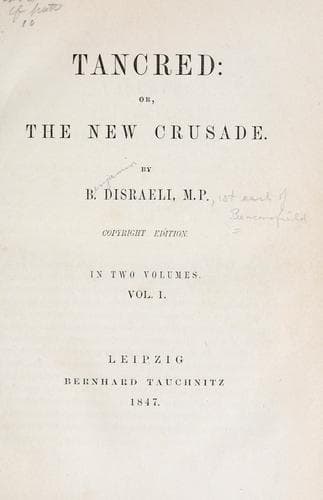
Tancred; Or, The New CrusadeDisraeli, Benjamin, Earl of Beaconsfield
ReligionJewish
Tancred; Or, The New Crusade
Disraeli, Benjamin, Earl of Beaconsfield
Christianity and other religions -- Judaism -- Fiction; Judaism -- Relations -- Christianity -- Fiction
And, indeed, nothing was more amusing than to see Lord Eskdale,
imperturbable, yet not heedless, with his peculiar calmness, something
between that of a Turkish pasha and an English jockey, standing up
with his back to the fire and his hands in his pockets, and hearing the
united statement of a case by the Duke and Duchess of Bellamont;
the serious yet quiet and unexaggerated narrative of his Grace, the
impassioned interruptions, decided opinions, and lively expressions
of his wife, when she felt the duke was not doing justice to the
circumstances, or her view of them, and the Spartan brevity with which,
when both his clients were exhausted, their counsel summed up the whole
affair, and said three words which seemed suddenly to remove all
doubts, and to solve all difficulties. In all the business of life, Lord
Eskdale, though he appreciated their native ability, and respected
their considerable acquirements, which he did not share, looked upon his
cousins as two children, and managed them as children; but he was really
attached to them, and the sincere attachment of such a character is
often worth more than the most passionate devotion. The last great
domestic embarrassment at Montacute had been the affair of the cooks.
Lord Eskdale had taken this upon his own shoulders, and, writing to
Daubuz, had sent down Leander and his friends to open the minds and
charm the palates of the north.
Lord Valentine and his noble parents, and their daughter, Lady
Florentina, who was a great horsewoman, also arrived. The countess, who
had once been a beauty with the reputation of a wit, and now set up for
being a wit on the reputation of having been a beauty, was the lady of
fashion of the party, and scarcely knew anybody present, though there
were many who were her equals and some her superiors in rank. Her way
was to be a little fine, always smiling and condescendingly amiable;
when alone with her husband shrugging her shoulders somewhat, and vowing
that she was delighted that Lord Eskdale was there, as she had somebody
to speak to. It was what she called ‘quite a relief.’ A relief, perhaps,
from Lord and Lady Mountjoy, whom she had been avoiding all her life;
unfortunate people, who, with a large fortune, lived in a wrong square,
and asked to their house everybody who was nobody; besides, Lord
Mountjoy was vulgar, and laughed too loud, and Lady Mountjoy called you
‘my dear,’ and showed her teeth. A relief, perhaps, too, from the Hon.
and Rev. Montacute Mountjoy, who, with Lady Eleanor, four daughters
and two sons, had been invited to celebrate the majority of the future
chieftain of their house. The countess had what is called ‘a horror of
those Mountjoys, and those Montacute Mountjoys,’ and what added to her
annoyance was, that Lord Valentine was always flirting with the Misses
Montacute Mountjoy.
Public-domain text, read in full here on John Shaqi.
Reviews
Reviews
No reviews yet
Be the first to share your thoughts on this work.
Join the Discussion
Join the discussion
Sign in to leave a comment or review.
Sign InorCreate an account