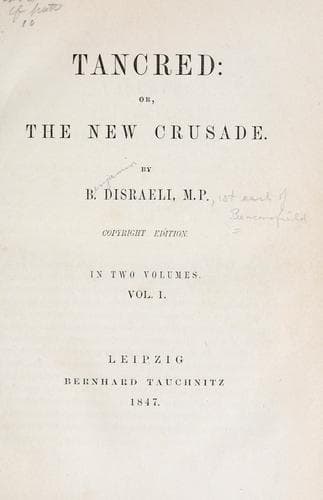
Tancred; Or, The New CrusadeDisraeli, Benjamin, Earl of Beaconsfield
ReligionJewish
Tancred; Or, The New Crusade
Disraeli, Benjamin, Earl of Beaconsfield
Christianity and other religions -- Judaism -- Fiction; Judaism -- Relations -- Christianity -- Fiction
‘Besides,’ added the duke, after a moment’s pause, and inferring, from
the silence of his son, that he was making an impression, ‘suppose
Hungerford is not in the same humour this time three years which he is
in now. Probably he may be; possibly he may not. Men do not like to
be baulked when they think they are doing a very kind and generous and
magnanimous thing. Hungerford is not a warming-pan; we must remember
that; he never was originally, and if he had been, he has been member
for the county too long to be so considered now. I should be placed in
a most painful position, if, this time three years, I had to withdraw my
support from Hungerford, in order to secure your return.’
‘There would be no necessity, under any circumstances, for that, my dear
father,’ said Lord Montacute, looking up, and speaking in a voice which,
though somewhat low, was of that organ that at once arrests attention; a
voice that comes alike from the brain and from the heart, and seems made
to convey both profound thought and deep emotion. There is no index of
character so sure as the voice. There are tones, tones brilliant and
gushing, which impart a quick and pathetic sensibility: there are others
that, deep and yet calm, seem the just interpreters of a serene and
exalted intellect. But the rarest and the most precious of all voices
is that which combines passion and repose; and whose rich and restrained
tones exercise, perhaps, on the human frame a stronger spell than even
the fascination of the eye, or that bewitching influence of the hand,
which is the privilege of the higher races of Asia.
‘There would be no necessity, under any circumstances, for that, my dear
father,’ said Lord Montacute, ‘for, to be frank, I believe I should feel
as little disposed to enter Parliament three years hence as now.’
The duke looked still more surprised. ‘Mr. Fox was not of age when he
took his seat,’ said his Grace. ‘You know how old Mr. Pitt was when
he was a minister. Sir Robert, too, was in harness very early. I have
always heard the good judges say, Lord Esk-dale, for example, that a man
might speak in Parliament too soon, but it was impossible to go in too
soon.’
‘If he wished to succeed in that assembly,’ replied Lord Montacute,
‘I can easily believe it. In all things an early initiation must be of
advantage. But I have not that wish.’
‘I don’t like to see a man take his seat in the House of Lords who has
not been in the House of Commons. He seems to me always, in a manner,
unfledged.’
‘It will be a long time, I hope, my dear father, before I take my seat
in the House of Lords,’ said Lord Montacute, ‘if, indeed, I ever do.’
‘In the course of nature ‘tis a certainty.’
‘Suppose the Duke’s plan for perpetuating an aristocracy do not
succeed,’ said Lord Montacute, ‘and our house ceases to exist?’
Public-domain text, read in full here on John Shaqi.
Reviews
Reviews
No reviews yet
Be the first to share your thoughts on this work.
Join the Discussion
Join the discussion
Sign in to leave a comment or review.
Sign InorCreate an account