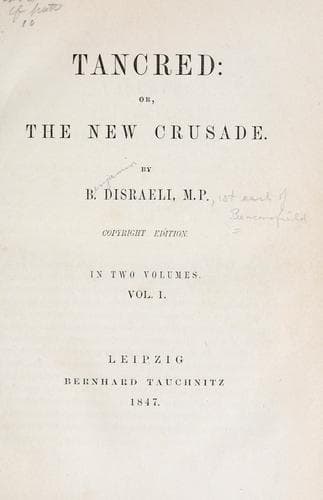
Tancred; Or, The New CrusadeDisraeli, Benjamin, Earl of Beaconsfield
ReligionJewish
Tancred; Or, The New Crusade
Disraeli, Benjamin, Earl of Beaconsfield
Christianity and other religions -- Judaism -- Fiction; Judaism -- Relations -- Christianity -- Fiction
‘We must take a general view of things to form an opinion,’ said his
father, mildly. ‘The general condition of England is superior to that of
any other country; it cannot be denied that, on the whole, there is more
political freedom, more social happiness, more sound religion, and more
material prosperity among us, than in any nation in the world.’
‘I might question all that,’ said his son; ‘but they are considerations
that do not affect my views. If other States are worse than we are, and
I hope they are not, our condition is not mended, but the contrary, for
we then need the salutary stimulus of example.’
‘There is no sort of doubt,’ said the duke, ‘that the state of England
at this moment is the most flourishing that has ever existed, certainly
in modern times. What with these railroads, even the condition of the
poor, which I admit was lately far from satisfactory, is infinitely
improved. Every man has work who needs it, and wages are even high.’
‘The railroads may have improved, in a certain sense, the condition of
the working classes almost as much as that of members of Parliament.
They have been a good thing for both of them. And if you think that more
labour is all that is wanted by the people of England, we may be
easy for a time. I see nothing in this fresh development of material
industry, but fresh causes of moral deterioration. You have announced to
the millions that there welfare is to be tested by the amount of their
wages. Money is to be the cupel of their worth, as it is of all other
classes. You propose for their conduct the least ennobling of all
impulses. If you have seen an aristocracy invariably become degraded
under such influence; if all the vices of a middle class may be traced
to such an absorbing motive; why are we to believe that the people
should be more pure, or that they should escape the catastrophe of the
policy that confounds the happiness with the wealth of nations?’
The duke shook his head and then said, ‘You should not forget we live in
an artificial state.’
‘So I often hear, sir,’ replied his son; ‘but where is the art? It seems
to me the very quality wanting to our present condition. Art is order,
method, harmonious results obtained by fine and powerful principles. I
see no art in our condition. The people of this country have ceased to
be a nation. They are a crowd, and only kept in some rude provisional
discipline by the remains of that old system which they are daily
destroying.’
‘But what would you do, my dear boy?’ said his Grace, looking up
very distressed. ‘Can you remedy the state of things in which we find
ourselves?’
‘I am not a teacher,’ said Lord Montacute, mournfully; ‘I only ask you,
I supplicate you, my dear father, to save me from contributing to this
quick corruption that surrounds us.’
‘You shall be master of your own actions. I offer you counsel, I give no
commands; and, as for the rest, Providence will guard us.’
Public-domain text, read in full here on John Shaqi.
Reviews
Reviews
No reviews yet
Be the first to share your thoughts on this work.
Join the Discussion
Join the discussion
Sign in to leave a comment or review.
Sign InorCreate an account