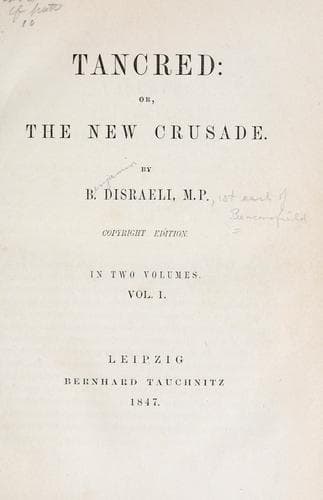
Tancred; Or, The New CrusadeDisraeli, Benjamin, Earl of Beaconsfield
ReligionJewish
Tancred; Or, The New Crusade
Disraeli, Benjamin, Earl of Beaconsfield
Christianity and other religions -- Judaism -- Fiction; Judaism -- Relations -- Christianity -- Fiction
‘My father,’ said Lord Montacute, and moving, he drew a chair to the
table, and seated himself by the duke, ‘you possess and have a right to
my confidence. I ought not to have said that I doubted about what was
good; for I know you.’
‘Sons like you make good fathers.’
‘It is not always so,’ said Lord Montacute; ‘you have been to me more
than a father, and I bear to you and to my mother a profound and fervent
affection; an affection,’ he added, in a faltering tone, ‘that is rarer,
I believe, in this age than it was in old days. I feel it at this moment
more deeply,’ he continued, in a firmer tone, ‘because I am about to
propose that we should for a time separate.’
The duke turned pale, and leant forward in his chair, but did not speak.
‘You have proposed to me to-day,’ continued Lord Montacute, after a
momentary pause, ‘to enter public life. I do not shrink from its duties.
On the contrary, from the position in which I am born, still more from
the impulse of my nature, I am desirous to fulfil them. I have meditated
on them, I may say, even for years. But I cannot find that it is part of
my duty to maintain the order of things, for I will not call it system,
which at present prevails in our country. It seems to me that it cannot
last, as nothing can endure, or ought to endure, that is not founded
upon principle; and its principle I have not discovered. In nothing,
whether it be religion, or government, or manners, sacred or political
or social life, do I find faith; and if there be no faith, how can there
be duty? Is there such a thing as religious truth? Is there such a thing
as political right? Is there such a thing as social propriety? Are these
facts, or are they mere phrases? And if they be facts, where are they
likely to be found in England? Is truth in our Church? Why, then, do
you support dissent? Who has the right to govern? The monarch? You have
robbed him of his prerogative. The aristocracy? You confess to me that
we exist by sufferance. The people? They themselves tell you that they
are nullities. Every session of that Parliament in which you wish to
introduce me, the method by which power is distributed is called in
question, altered, patched up, and again impugned. As for our morals,
tell me, is charity the supreme virtue, or the greatest of errors? Our
social system ought to depend on a clear conception of this point. Our
morals differ in different counties, in different towns, in different
streets, even in different Acts of Parliament. What is moral in London
is immoral in Montacute; what is crime among the multitude is only vice
among the few.’
‘You are going into first principles,’ said the duke, much surprised.
‘Give me then second principles,’ replied his son; ‘give me any.’
Public-domain text, read in full here on John Shaqi.
Reviews
Reviews
No reviews yet
Be the first to share your thoughts on this work.
Join the Discussion
Join the discussion
Sign in to leave a comment or review.
Sign InorCreate an account