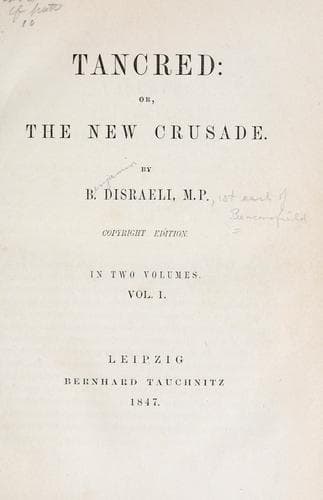
Tancred; Or, The New CrusadeDisraeli, Benjamin, Earl of Beaconsfield
ReligionJewish
Tancred; Or, The New Crusade
Disraeli, Benjamin, Earl of Beaconsfield
Christianity and other religions -- Judaism -- Fiction; Judaism -- Relations -- Christianity -- Fiction
It will be seen, therefore, that his lordship was one of those
characters not ill-adapted to an eminent station in an age like the
present, and in a country like our own; an age of movement, but of
confused ideas; a country of progress, but too rich to risk much change.
Under these circumstances, the spirit of a period and a people seeks a
safety-valve in bustle. They do something, lest it be said that they
do nothing. At such a time, ministers recommend their measures as
experiments, and parliaments are ever ready to rescind their votes.
Find a man who, totally destitute of genius, possesses nevertheless
considerable talents; who has official aptitude, a volubility of routine
rhetoric, great perseverance, a love of affairs; who, embarrassed
neither by the principles of the philosopher nor by the prejudices of
the bigot, can assume, with a cautious facility, the prevalent tone, and
disembarrass himself of it, with a dexterous ambiguity, the moment it
ceases to be predominant; recommending himself to the innovator by his
approbation of change ‘in the abstract,’ and to the conservative by his
prudential and practical respect for that which is established; such
a man, though he be one of an essentially small mind, though his
intellectual qualities be less than moderate, with feeble powers of
thought, no imagination, contracted sympathies, and a most loose public
morality; such a man is the individual whom kings and parliaments
would select to govern the State or rule the Church. Change, ‘in the
abstract,’ is what is wanted by a people who are at the same time
inquiring and wealthy. Instead of statesmen they desire shufflers; and
compromise in conduct and ambiguity in speech are, though nobody will
confess it, the public qualities now most in vogue.
Not exactly, however, those calculated to meet the case of Tancred.
The interview was long, for Tan-cred listened with apparent respect
and deference to the individual under whose auspices he had entered the
Church of Christ; but the replies to his inquiries, though more adroit
than the duke’s, were in reality not more satisfactory, and could not,
in any way, meet the inexorable logic of Lord Montacute. The bishop
was as little able as the duke to indicate the principle on which the
present order of things in England was founded; neither faith nor
its consequence, duty, was at all illustrated or invigorated by his
handling. He utterly failed in reconciling a belief in ecclesiastical
truth with the support of religious dissent. When he tried to define
in whom the power of government should repose, he was lost in a maze of
phrases, and afforded his pupil not a single fact.
‘It cannot be denied,’ at length said Tancred, with great calmness,
‘that society was once regulated by God, and that now it is regulated by
man. For my part, I prefer divine to self-government, and I wish to know
how it is to be attained.’
‘The Church represents God upon earth,’ said the bishop.
Public-domain text, read in full here on John Shaqi.
Reviews
Reviews
No reviews yet
Be the first to share your thoughts on this work.
Join the Discussion
Join the discussion
Sign in to leave a comment or review.
Sign InorCreate an account