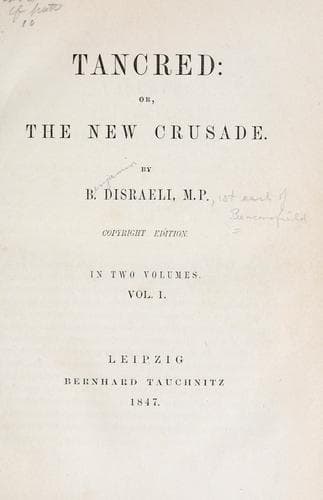
Tancred; Or, The New CrusadeDisraeli, Benjamin, Earl of Beaconsfield
ReligionJewish
Tancred; Or, The New Crusade
Disraeli, Benjamin, Earl of Beaconsfield
Christianity and other religions -- Judaism -- Fiction; Judaism -- Relations -- Christianity -- Fiction
‘But the Church no longer governs man,’ replied Tancred.
‘There is a great spirit rising in the Church,’ observed the bishop,
with thoughtful solemnity; ‘a great and excellent spirit. The Church of
1845 is not the Church of 1745. We must remember that; we know not what
may happen. We shall soon see a bishop at Manchester.’
‘But I want to see an angel at Manchester.’
‘An angel!’
‘Why not? Why should there not be heavenly messengers, when heavenly
messages are most wanted?’
‘We have received a heavenly message by one greater than the angels,’
said the bishop. ‘Their visits to man ceased with the mightier advent.’
‘Then why did angels appear to Mary and her companions at the holy
tomb?’ inquired Tancred.
The interview from which so much was anticipated was not satisfactory.
The eminent prelate did not realise Tancred’s ideal of a bishop, while
his lordship did not hesitate to declare that Lord Montacute was a
visionary.
CHAPTER XI.
_Advice from a Man of the World_
WHEN the duchess found that the interview with the bishop had been
fruitless of the anticipated results, she was staggered, disheartened;
but she was a woman of too high a spirit to succumb under a first
defeat. She was of opinion that his lordship had misunderstood the case,
or had mismanaged it; her confidence in him, too, was not so illimitable
since he had permitted the Puseyites to have candles on their altars,
although he had forbidden their being lighted, as when he had declared,
twenty years before, that the finger of God was about to protestantise
Ireland. His lordship had said and had done many things since that
time which had occasioned the duchess many misgivings, although she had
chosen that they should not occur to her recollection until he failed in
convincing her son that religious truth was to be found in the parish
of St. James, and political justice in the happy haunts of Montacute
Forest.
The Bishop had voted for the Church Temporalities’ Bill in 1833, which
at one swoop had suppressed ten Irish episcopates. This was a queer
suffrage for the apostle of the second Reformation. True it is that
Whiggism was then in the ascendant, and two years afterwards, when
Whiggism had received a heavy blow and great discouragement; when we had
been blessed in the interval with a decided though feeble Conservative
administration, and were blessed at the moment with a strong though
undecided Conservative opposition; his lordship, with characteristic
activity, had galloped across country into the right line again,
denounced the Appropriation Clause in a spirit worthy of his earlier
days, and, quite forgetting the ten Irish bishoprics, that only
four-and-twenty months before he had doomed to destruction, was all for
proselytising Ireland again by the efficacious means of Irish Protestant
bishops.
Public-domain text, read in full here on John Shaqi.
Reviews
Reviews
No reviews yet
Be the first to share your thoughts on this work.
Join the Discussion
Join the discussion
Sign in to leave a comment or review.
Sign InorCreate an account