That all classes of the community in this country have derived much
benefit from the persistent use of Tea, is placed beyond dispute. It
has proved, and still proves, a highly prized boon to millions. The
artist at his easel, the author at his desk, the statesman fresh from
an exhaustive oration, the actor from the stage after fulfilling an
arduous _rôle_, the orator from the platform, the preacher from the
pulpit, the toiling mechanic, the wearied labourer, the poor governess,
the tired laundress, the humble cottage housewife, the votary of
pleasure even, on escaping from the scene of revelry, nay, the Queen on
her throne, have, one and all, to acknowledge and express gratitude for
the grateful and invigorating infusion.
Shortly after it had became fashionable to partake of Tea, persons of
quality in England were wont to invite their friends to a “dish” of the
newly-imported beverage. Lord Macaulay mentions how “Tea, which at the
time Monk brought the Army of Scotland to London (A. D. 1660), had
been handed round to be stared at and just touched with the lips as a
great rarity of China, was, eighty years later, a regular article of
import, and was soon consumed in such quantities that financiers began
to consider it as an important source of revenue.” Seven years later
Pepys has this entry in his famous Diary: “Home, and there find my wife
making of Tea, a drink which Mr. Pelling, the apothicary, tells her is
good for her cold.” That Queen Anne ranked among the votaries of the
leaf is manifest from Pope’s couplet:--
“Thou, great Anna, whom three realms obey,
Dost sometimes counsel take, and sometimes Tay.”
From this time forth writers of renown make constant allusions to
the new drink. Essayists in the _Spectator_, the _Tatler_, and other
literary organs, are ever dropping remarks respecting the tea-table.
Pope, in his “Rape of the Lock,” when Belinda is declaring what
terrible things she would rather have had happen, than have lost her
favourite curl, makes her cap everything by the wish that she could be
transported to--
“Some isle
Where the gilt chariot never marks the way,
Where none learn ombre, none e’er drink Bohea,”--
than which privation she can imagine nothing worse.
Then what a source of social pleasure the “afternoon Tea” becomes!
Brady, in his well known metrical version of the “Psalms,” thus
illustrates the advantages accruing therefrom:--
“When in discourse of Nature’s mystic powers
And noblest themes, we pass the well spent hours,
Whilst all around the Virtues--sacred band--
And listening Graces, pleased attendants stand.
Thus our Tea conversations we employ,
Where with delight, instruction we enjoy,
Quaffing without the waste of time or wealth,
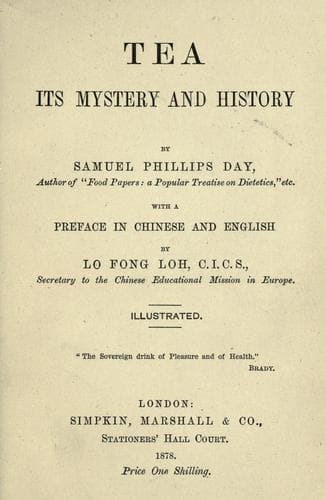
The sovereign drink of pleasure and of health.”
Public-domain text, read in full here on John Shaqi.
Reviews
Reviews
No reviews yet
Be the first to share your thoughts on this work.
Join the Discussion
Join the discussion
Sign in to leave a comment or review.
Sign InorCreate an account