Ideographic and phonetic at the same time, the mechanism of the
language is intelligible only to a few Europeans; but it is truly
surprising that the vernacular of 400,000,000 of our fellow-men, whose
literature dates from the time of King David, and whose yearly exchange
of merchandise with England amounts to £40,000,000 sterling, should
have been so long wrapped in oblivion.
China does not possess, as we do, public libraries and reading rooms,
but all who have a taste for reading or desire instruction can readily
satisfy their need, as books are sold in the Celestial Empire at prices
lower than in any other country in the world; further, all the finest
quotations from the best authors are found written on the pagodas,
public monuments, façades of tribunals, signs of the shops, doors of
houses, and interior of apartments, so that, in fact, China may be
likened to a huge library, where rich and poor alike can enjoy their
country’s literature, and it is deserving of remark that the general
prosperity and peace of China has been much promoted by the diffusion
of knowledge and education throughout the lower classes.
The construction of the Chinese symbols varies from the square
character to the more cursive character of the Seal and Grass, peculiar
for their obscurity. The six styles of writing are as follows:--Chuen
shoo, or Seal character; Le shoo, or Official character; Keae shoo, or
Model character; Hing shoo, or Running character; Tsaov shoo, or Grass
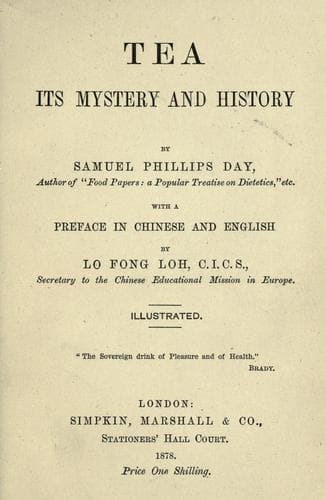
character; and Sung shoo, or Sung dynasty character. The preface to
this book is written by Lo Fong Loh, Esq., in the “running” character,
and is undoubtedly a perfect specimen of caligraphy; his translation is
rendered in the following pages.
[Illustration]
EXTRACT FROM MR. LO FONG LOH’S JOURNAL.
Among the several places of interest in London, visited by H. E. Li
Fung Pao (Director of the Chinese Educational Mission) and myself
during our six months’ sojourn therein, I could not fail to be
impressed with the Tea Establishment of Messrs. Horniman and Co.,
Wormwood Street. The first department to which our attention was
directed, is called the “Blending Floors.” Here we observed divers
descriptions of Tea, which had been shipped from different countries
in the Eastern Hemisphere. Although we do not profess to be _au
courant_ with regard to that particular article of domestic use, still
we happen to come from the Tea districts of China, and therefore took
the opportunity of examining some specimens of the tropical leaf.
Public-domain text, read in full here on John Shaqi.
Reviews
Reviews
No reviews yet
Be the first to share your thoughts on this work.
Join the Discussion
Join the discussion
Sign in to leave a comment or review.
Sign InorCreate an account