Shortly after my arrival in England, I felt distressed respecting
the means of procuring pure Tea, not drinking coloured Tea in my own
country. I experienced that some of the largest hotels and leading
restaurants seldom produced a beverage such as I could with pleasure
drink. Upon trying the Tea supplied by Messrs. Horniman’s Agents, I
found it excellent in every respect, and like to that I have been
accustomed to use when at home.
One object of my official visit to Europe being to collect special
information bearing on the Industrial Arts, as evidences of Western
civilisation, I must confess that both H. E. Li and myself derived
mutual pleasure and profit in going over Messrs. Horniman’s
Establishment.
LO FONG LOH.
_London, May, 1878._
[Illustration]
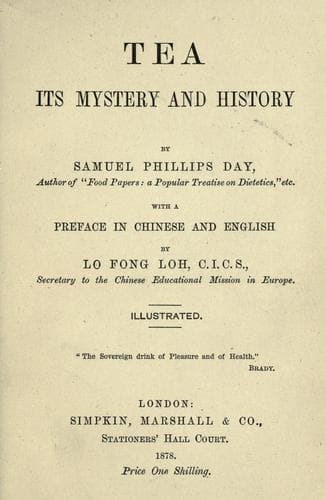
TEA
ITS MYSTERY AND HISTORY.
CHAPTER I.
LEGENDARY ORIGIN OF THE PLANT.
According to the most authentic Chinese historians, the Tea plant was
introduced from the Corea in the eighth century, during the dynasty
of Lyang. Being both approved of and much relished by the Emperor it
was extensively cultivated, so that it rapidly became popular with all
sections of the community. As this story was too prosaic for general
acceptation, the masses, and even certain sceptical _literati_, readily
received a more poetical account, which, like many of our own nursery
tales, veils some political allegory.
The story runs, that in the year 510, an Indian prince--one Darma,
third son of King Kosjusva--famed throughout the East for his religious
zeal, landed in China on a Missionary enterprise. He devoted all his
time and thought to the diffusion of a knowledge of God. In order
to set an example of piety to others, he imposed on himself various
privations and mortifications, forswore sleep, and, living mostly in
the open air, devoted himself to prayer, preaching, and contemplation.
However, after several years passed in this excessively austere
manner, he involuntarily fell asleep. Upon awaking, so distressed was
he at having violated his oath that, to prevent a repetition of such
backsliding and never again permit “tired eyelids” to “rest on tired
eyes,” he cut off those offending portions of his body, and flung them
on the ground. Returning next day to the same spot, he discovered that
his eyelids had undergone a strange metamorphosis, having been changed
into a shrub the like of which had never before been seen upon the
earth. Having eaten some of the leaves, he found his spirits singularly
exhilarated thereby; while his former vigour was restored. Hence he
recommended the newly-discovered boon to his disciples and followers,
so that after a time the use of Tea rapidly spread. A portrait of
Darma is given by Kæmpfu, the first authoritative writer on China. At
the foot of the portrait is the representation of a reed, supposed to
be indicative of the religious enthusiast having crossed rivers and
seas in the pursuit of his mission. It is by no means difficult, out
Public-domain text, read in full here on John Shaqi.
Reviews
Reviews
No reviews yet
Be the first to share your thoughts on this work.
Join the Discussion
Join the discussion
Sign in to leave a comment or review.
Sign InorCreate an account