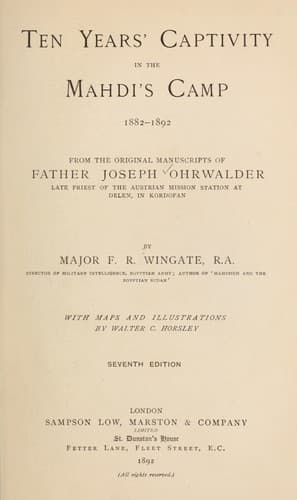
Ten Years' Captivity in the Mahdi's Camp 1882-1892Ohrwalder, Josef
Religion
Ten Years' Captivity in the Mahdi's Camp 1882-1892
Ohrwalder, Josef
Mahdi, Muhammad Ahmad, 1848-1885; Sudan -- History
The Mahdi was utterly opposed to all these evil habits, and during his
life matters greatly improved; but this was due rather to the fact that
the whole country was under arms, and that the towns were practically
deserted. Besides, punishment for such crimes was ungrudgingly given,
and the stoppage of marissa-drinking also tended to lessen the evils.
Marriage ceremonies were simplified and made less expensive, and a
distinct advance in public morality was apparent.
But when the principal fighting was over, and the victorious emirs gave
themselves over to a life of luxury and debauchery, when idle town life
took the place of religious campaigns, when houses were built of mud and
bricks instead of rough straw huts, and when the Mahdi died, then
immorality broke forth with the redoubled violence of long compression,
and the state of affairs became infinitely worse than it had ever been
in the old Government days. I refer especially to Omdurman. Constant
warfare had greatly diminished the male population. Omdurman was full of
women who had neither husbands nor male relations; and this is the real
cause of the evil state of affairs.
Matters reached such a pitch in 1888 that the Khalifa issued an order
that every unmarried woman must be provided with a husband within three
days, or she would be handed over to a Baggara as a slave or concubine.
In consequence of this order, for the space of three days the whole town
was continuously occupied in marriage ceremonies. Men seized this
opportunity of taking women whom they would never, under other
circumstances, have been allowed to marry; and of course these forced
marriages could not be of long duration--in a month or two most of the
couples were separated.
Another cause which tended towards immorality was the fact that numbers
of men had been sent off to far-distant parts of the country on
expeditions, unaccompanied by their wives, most of whom were left in
Omdurman for years; and it is hardly to be wondered at if in time they
began to forget their husbands and to form unlawful connections, in
which the Khalifa had frequently to interfere.
On one occasion upwards of eighty women, whose infidelity to their
husbands was unquestionable, were put in prison, and a council held to
consider what should be done to them. It was decided to make an example
of one, and the victim selected was an unfortunate who had borne two
illegitimate children. The poor creature was led into the women's
quarter of the market, and there she was lowered into a grave with her
last child tied to her bosom, and both stoned to death by a cruel and
hard-hearted crowd, who seemed to take a fiendish delight in this
inhuman piece of work.
Public-domain text, read in full here on John Shaqi.
Reviews
Reviews
No reviews yet
Be the first to share your thoughts on this work.
Elsewhere in the archive
Join the Discussion
Join the discussion
Sign in to leave a comment or review.
Sign InorCreate an account