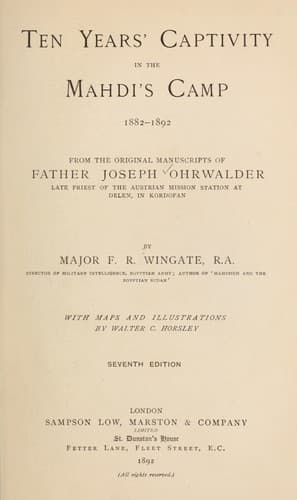
Ten Years' Captivity in the Mahdi's Camp 1882-1892Ohrwalder, Josef
Religion
Ten Years' Captivity in the Mahdi's Camp 1882-1892
Ohrwalder, Josef
Mahdi, Muhammad Ahmad, 1848-1885; Sudan -- History
In matters, however, regarding war and the preparations required for a
jehad, it is entirely different. Blacksmiths are always busy forging
spears and knives; and in this description of work the results are
remarkable. Saddlers make every description of leather ornament for
horse and camel decoration; tanners prepare the leather, and dye it red
or black; tailors now make much better jibbehs than before; the patches
are generally made of good cloth, and the best garments are now valued
at about sixteen dollars each. The women spin the cotton, and the men
weave the dammur from it. The best dammur comes from Berber and
Metemmeh. The Darfur women are also famed for their good and even
spinning; but Abyssinian dammur is generally considered better than any
of Sudan manufacture.
Tin-smiths make drinking cups and tin receptacles of various sorts for
household use. Cooking-pots are made of copper. Jewellers make gold and
silver filigree work for the ladies; but this work is not nearly as good
as it used to be in the days of the Egyptian Government. All these
various trades are carried on in the market.
[Illustration: A SLAVE-GIRL FROM EQUATORIA.]
Mahdiism has re-established the slave trade, which is now in full
vigour, and almost all those slaves who were liberated in the
Government days have been sold again as slaves. Wherever there is a beit
el mal there is also a slave-market. The largest is, of course, in
Omdurman, to which all captured slaves are sent. The beit el mal sells
the slaves by auction. Well-grown male slaves are generally taken into
the army.
Close to the beit el mal is the female slave-market, where generally
fifty or sixty women of various ages are to be found. The slave-dealers
are for the most part Egyptians. The slaves are arranged in lines under
the open sky; their bodies are generally well bathed in oil to preserve
the gloss of their skin. Intending purchasers make the most careful and
minute examination, and the price varies from twenty to a hundred
dollars.
Young females are kept apart from the rest, as they are generally
selected as concubines, and as such they are subjected to a most
critical scrutiny; the shape of their hands and feet, and the form of
their mouth, nose, ears and teeth are all carefully noted. Black are
preferable to copper-coloured slaves, and the latter colour necessitates
a considerable reduction in price.
Young male slaves are sold at from thirty to sixty dollars each, and
these have generally to learn a trade. Purchasers ask all sorts of
searching questions as to whether they have good moral qualities, are
likely to run away, &c., &c. The salesman must produce a certificate
showing the tribe, a full descriptive return, and the legal authority
entitling to ownership.
Public-domain text, read in full here on John Shaqi.
Reviews
Reviews
No reviews yet
Be the first to share your thoughts on this work.
Elsewhere in the archive
Join the Discussion
Join the discussion
Sign in to leave a comment or review.
Sign InorCreate an account