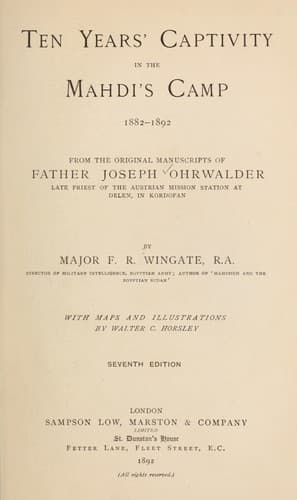
Ten Years' Captivity in the Mahdi's Camp 1882-1892Ohrwalder, Josef
Religion
Ten Years' Captivity in the Mahdi's Camp 1882-1892
Ohrwalder, Josef
Mahdi, Muhammad Ahmad, 1848-1885; Sudan -- History
During the early days of Mahdiism the slave trade received an enormous
impetus, more especially subsequent to the capture of Bahr el Ghazal and
the occupation of Darfur. After Gessi Pasha's victory over Zubeir
Pasha's son and the dispersion of the slave-dealers, several of the
latter fled into the interior, where pursuit was impossible; then
followed the era of liberty under the Mahdi's banner, the slave-dealers
emerged from their hiding-places, and, with quantities of slaves,
proceeded to Omdurman.
When at El Obeid I often saw as many as 500 of them marching along to
the sound of music. Slaves were dragged from Darfur, bound together
with leather thongs round their necks in batches of thirty. Abu Anga
brought thousands of them from the Nuba hills. The only districts
untouched hitherto were those in the vicinity of the White Nile, but
quite recently the garrisons of Fashoda, Regaf, and Lado have been
busily engaged in this human traffic; these blacks, however, who during
the intervals of peace had been gradually recovering their strength, now
determined to resist the Dervish authority, which was not very strong in
those far-distant districts. It would have been a great thing if the
Dervishes could have been turned out of Lado and Regaf. The Abyssinian
campaigns also brought quantities of slaves to Omdurman, but these are
little fitted for hard work, and are employed for the most part in
grinding corn, carrying water, and as concubines.
Slave-hunting, too, is not carried on in the same way as it used to be.
The Khalifa is too knowing to send large raiding expeditions for slaves
into the distant provinces, as he fears they might possibly become
independent and turn upon him; besides, private individuals are no
longer permitted to be in possession of firearms.
Blacks captured in the Khalifa's various wars are sold as slaves, and,
while the free Mussulman tribes have been greatly weakened and reduced
in numbers by war and famine, the blacks have, on the other hand, been
growing both in numbers and in strength. There is abundant proof of this
in the great difficulties which the Dervish force at Fashoda is now
experiencing, being scarcely strong enough to quit their steamers and
sailing boats. The inhabitants of Jebel Nuba are once more almost
independent, and now the Dervishes do not dare even to go to the foot of
the hills. The withdrawal also of the various Baggara tribes from the
neighbourhood of Shakka, &c., to Omdurman has rid the local blacks of
their hated presence in their country.
The once notorious Jaalin and Danagla slave-hunters are now beginning to
experience in a degree what a slave's life is, and, indeed, it almost
seems as if the Khalifa Abdullah was an instrument of Heaven's
vengeance on those bloodthirsty and ruthless slave-hunters.
Public-domain text, read in full here on John Shaqi.
Reviews
Reviews
No reviews yet
Be the first to share your thoughts on this work.
Elsewhere in the archive
Join the Discussion
Join the discussion
Sign in to leave a comment or review.
Sign InorCreate an account