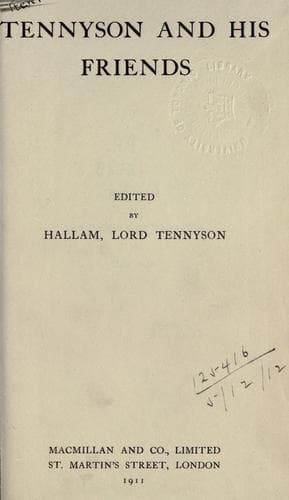
Tennyson, Alfred Tennyson, Baron, 1809-1892 -- Friends and associates
He was, perhaps, not exactly a scholar in what I may call the narrow
professional sense; but in the broadest and deepest and truest sense he
was a _great_ scholar. Direct imitations of classical form, even when they
show such power and poetry as Swinburne's "Atalanta" and "Erechtheus,"
have always something artificial about them. But in all Tennyson's classic
pieces--"Œnone," "Ulysses," "Demeter," "Tithonus," the legendary
subjects--and in the two historic subjects, "Lucretius" and "Boädicea,"
the classical tradition is there with full detail, but by the poet's art
it is transmuted. "Œnone" is epic in form, the rest are brief
monodramas; the material is all ancient, and in many subtle ways the
spirit; the handling is modern and original. In translations--too
few--Tennyson can only be called consummate: his version of one passage of
the _Iliad_ (viii. 552) makes all other translations seem second-rate. Let
me quote a few lines:
And these all night upon the bridge of war
Sat glorying; many a fire before them blazed:
As when in heaven the stars about the moon
Look beautiful, when all the winds are laid,
And every height comes out, and jutting peak
And valley, and _the immeasurable heavens
Break open to their highest_,[86] and all the stars
Shine, and the Shepherd gladdens in his heart:
So many a fire between the ships and stream
Of Xanthus blazed before the towers of Troy,
A thousand on the plain; and close by each
Sat fifty in the blaze of burning fire;
And eating hoary grain and pulse the steeds,
Fixt by their cars, waited the golden dawn.
The passage, let me add, is a crucial test of the power of a translator,
for this reason: it is a plain, simple description of the Trojan
camp-fires in the darkness, with a simile or comparison of the sight to a
clearance of the sky at night and the sudden shining of the multitude of
stars. With the infallible instinct of Greek Poetry there is a rapid lift
in the style, a sudden glorious phrase [Greek: huperragê aspetos aithêr],
to suggest adequately the magnificent sight of the sudden clearance. It is
this effect that is difficult to give in the translation; and it is
exactly this splendid climax that Tennyson's incomparable rendering, "And
the immeasurable heavens break open to their highest," so perfectly
conveys.
Again, in the metrical imitations--which are deliberately somewhat in the
vein of sport and artifice--Tennyson alone, it seems to me, has exactly
done what he intended, and shown what English effects can be produced by a
master's hand, even in these unfamiliar measures.
Public-domain text, read in full here on John Shaqi.
Reviews
Reviews
No reviews yet
Be the first to share your thoughts on this work.
Elsewhere in the archive
Join the Discussion
Join the discussion
Sign in to leave a comment or review.
Sign InorCreate an account