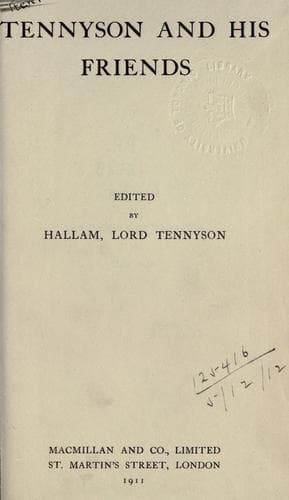
Tennyson, Alfred Tennyson, Baron, 1809-1892 -- Friends and associates
Of the serious classic pieces one of the most beautiful and moving is
"Tithonus." The tale is familiar: the beautiful youth Tithonus was beloved
by the goddess of the Dawn, and her love bestowed immortality on him; _but
they both forgot to ask for immortal youth_. So he grew old: and the
pathos of the boon, granted by love at love's request, thus turning out a
curse, is the motive of the tale. He speaks:
Yet hold me not for ever in thine East:
How can my nature longer mix with thine?
Coldly thy rosy shadows bathe me, cold
Are all thy lights, and cold my wrinkled feet
Upon thy glimmering thresholds, when the steam
Floats up from those dim fields about the homes
Of happy men that have the power to die,
And grassy barrows of the happier dead.
Release me, and restore me to the ground;
Thou seëst all things, thou wilt see my grave:
Thou wilt renew thy beauty morn by morn;
I earth in earth forget these empty courts,
And thee returning on thy silver wheels.
A great scholar has said that it is one of the most incomparable powers of
poetry _to make sad things beautiful_, and so to go some way towards
healing the sorrow in the reader's heart. He was speaking of Greek
Tragedy; but there is, I think, a deep truth in the saying, and it is not
confined to that particular form of poetry. And I know no better instance
of the truth than the singularly beautiful poem quoted above.
But the classic influences are, of course, not limited to the avowed
borrowings from ancient legend. There are constantly lines in Tennyson
where the student of ancient poetry recognizes a phrase--a turn--an
echo--beautiful in themselves, and giving a special pleasure to the
instructed reader; such a line as "When the first matin-song hath wakened
loud," which occurs in the "Address to Memory"--the striking early poem
containing the description of his Somersby home--and is itself an
exquisitely turned translation from Sophocles' _Electra_. So again we have
an echo from Homer through Virgil, in the half-playful line, "This way and
that dividing the swift mind"; or, again, the vivid simile from Theocritus
in the bold description:
And arms on which the standing muscles sloped,
As slopes a wild brook o'er a little stone,
Running too vehemently to break upon it.[87]
Public-domain text, read in full here on John Shaqi.
Reviews
Reviews
No reviews yet
Be the first to share your thoughts on this work.
Elsewhere in the archive
Join the Discussion
Join the discussion
Sign in to leave a comment or review.
Sign InorCreate an account