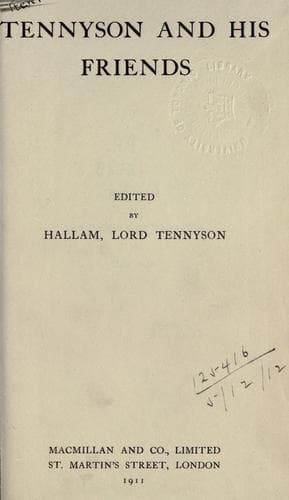
Tennyson, Alfred Tennyson, Baron, 1809-1892 -- Friends and associates
--where the reader with an ear will note the bold metrical variation
adding so much to the effect. So again the Poet himself has told us how
the famous phrase for the kingfisher, "The sea-blue bird of March," arose
one day when he was haunted by the lovely stanza of Alcman (Greek lyric
poet) about the "halcyon" whom he calls "the sea-blue bird of spring." The
fact is that Tennyson had an inborn instinct for the subtle power of
language, and for musical sound--in a word, for that insight, finish,
feeling for beauty in phrase and thought and _thing_, and that perfection
of form, which, taken all together, we call poetry, and he is, like Virgil
and Milton, a true son of the Greeks: and if his open imitations are few,
the influence of the springs from which he drank is none the less powerful
and pervading.
In 1842 came a carefully revised selection of the earlier books--he was
always revising and improving--along with a large number of new poems.
I will pass over the English Idylls, which, in spite of beautiful touches,
have never as a whole appealed to me. But, setting these aside, there are
a few pieces which I cannot pass by without a word. They are "Love and
Duty," the political poems, and songs. "Morte d'Arthur" I leave over till
we reach the Idylls.
"Love and Duty" is a passionate tragedy, the parting of two lovers at the
call of duty. Perhaps the high-wrought pathos is a sign of youth; but
youth may be a strength as well as a weakness; and the lines are surely of
extraordinary beauty and force. I will quote the last passage, for a
reason which will appear:
Should my Shadow cross thy thoughts
Too sadly for their peace, remand it thou
For calmer hours to Memory's darkest hold,
If not to be forgotten--not at once--
Not all forgotten. Should it cross thy dreams,
O might it come like one that looks content,
With quiet eyes unfaithful to the truth,
And point thee forward to a distant light,
Or seem to lift a burthen from thy heart
And leave thee freër, till thou wake refresh'd
Then when the first low matin-chirp hath grown
Full quire, and morning driv'n her plow of pearl
Far furrowing into light the mounded rack,
Beyond the fair green field and eastern sea.
Public-domain text, read in full here on John Shaqi.
Reviews
Reviews
No reviews yet
Be the first to share your thoughts on this work.
Elsewhere in the archive
Join the Discussion
Join the discussion
Sign in to leave a comment or review.
Sign InorCreate an account