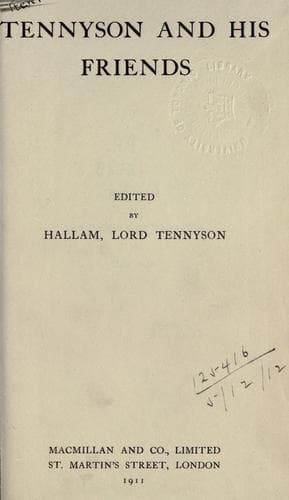
Tennyson, Alfred Tennyson, Baron, 1809-1892 -- Friends and associates
"The landlord"--at Folkestone--"gave two bottles of his claret, and I
think I drank the most, and here I have been lying back in the chair
and thinking of those delightful 'Idylls'; my thoughts being turned to
you; and what could I do but be grateful to that surprising genius
which has made me so happy?"
The Duke of Argyll wrote that Macaulay had been _delighted with it_,
whereupon the Poet responds to his Grace somewhat caustically:
MY DEAR DUKE--Doubtless Macaulay's good opinion is worth having, and I
am grateful to you for letting me know it, but this time I intend to
be thick-skinned; nay, I scarcely believe that I should ever feel very
deeply the pen-punctures of those parasitic animalcules of the press,
if they kept themselves to what I write, and did not glance spitefully
and personally at myself. I hate spite.
Ruskin, on the other hand, is but half pleased; could not quite make up
his mind about that "increased quietness of style"; feels "the art and
finish in these poems a little more than I like"; wishes that the book's
nobleness and tenderness had been independent of a romantic condition of
externals; and suggests that "so great power ought not to be spent on
visions of things past, but on the living present."
These latter sentences touch upon, or at least indicate, a line of
criticism upon the general conception of the "Idylls," as seen in their
treatment of the Arthurian legend, with which, although it may appear
inadequate, some of us are not indisposed to agree. Romanticism has been
defined, half seriously, as the art of presenting to a people the literary
works which can give the greatest imaginative pleasure in the actual state
of their habits and beliefs. The "Idylls" adapted the mythical tales of
the Round Table to the very highest standard of æsthetic taste,
intellectual refinement, and moral delicacy prevailing in cultivated
English society. And by that society they were very cordially appreciated.
Undoubtedly the figure of Arthur--representing a stainless mirror of
chivalry, a warrior king endowed with the qualities of patriotic
self-devotion, clemency, generosity, and noble trustfulness, yet betrayed
by his wife and his familiar friend, and dying in a lost fight against
treacherous rebels--did present a lofty ideal that might well affect a
gravely emotional people. Moreover, the poem is a splendidly illuminated
Morality, unfolding scenes and figures that illustrate heroic virtues and
human frailties, gallantry, chivalric enterprise, domestic perfidy, chaste
virginal loves, and subtle amorous enchantments. It abounds also in
descriptive passages which attest the close attention of the Poet's eye
and ear to natural sights and sounds, and his supreme art of fashioning
his verse to their colours and echoes. In short, to quote from the
biography,
Public-domain text, read in full here on John Shaqi.
Reviews
Reviews
No reviews yet
Be the first to share your thoughts on this work.
Elsewhere in the archive
Join the Discussion
Join the discussion
Sign in to leave a comment or review.
Sign InorCreate an account