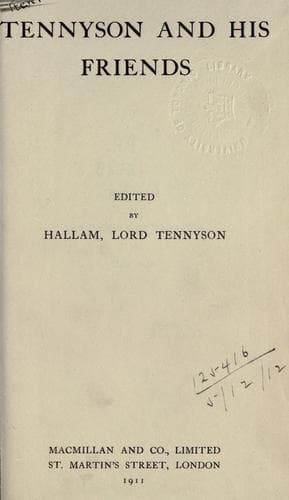
Tennyson, Alfred Tennyson, Baron, 1809-1892 -- Friends and associates
It was not unnatural, therefore, that he should have come to regard the
phenomena of spiritualism as the strongest evidence of those beliefs which
were to him more important than life itself, and, this conviction once
established, submission to the strange genius of Swedenborg followed
almost as a matter of course, for by his "science of correspondencies,"
the new phenomena seemed to fall naturally and inevitably into their
proper place in that strange dual scheme of spirit and matter into which
Swedenborg had resolved the Universe. When he had once embarked upon
Occultism, other curious beliefs followed in the train of these main
convictions. He became greatly impressed with the work of a certain Mr.
Melville who believed that he had rediscovered an ancient and long
forgotten method of reading the stars which was in fact the original
mystery of Freemasonry. Frederick took eagerly to this idea which seemed
to fall naturally into place with the Swedenborgian science of
correspondencies, and in 1872 he actually came to England with Mr.
Melville in the hope of being able to convince the Freemasons that all
modern Masonry with its boasted mysteries was futile and meaningless
without the key of Mr. Melville's discovery in which lay the true
explanation of all the masonic signs and symbols. Unfortunately an
interview with the Duke of Leinster, the then Grand Master, gave the two
apostles little satisfaction. It was on this visit that Frederick saw
FitzGerald for the last time, and the latter described him to Mrs. Kemble
as being "quite grand and sincere in this as in all else; with the Faith
of a gigantic child--pathetic and yet humorous to consider and consort
with."
The influence of these ideas gradually coloured Frederick's view on all
current subjects. His years in Florence had been spent in the "hubbub of
imminent war," and he writes indignantly of "the rottenness of these
pitiable petty States and the incredible fantastic tricks of their
abominable rulers." None the less, though he hated and despised most
existing monarchies, he was too much imbued with the romance and dignity
of the past to look with a very favourable eye on revolution. At first he
dismissed Mazzini as "deserving a hempen collar with Nana Sahib and the
King of Delhi," an opinion which the experience of later years compelled
him to reverse. The story of nineteenth-century Europe seemed to him
chaos, but it was the chaos which was to precede the new spiritual
dispensation, and political prejudice never hindered him from the true
appreciation of progress. Thus he writes in 1869:
Public-domain text, read in full here on John Shaqi.
Reviews
Reviews
No reviews yet
Be the first to share your thoughts on this work.
Join the Discussion
Join the discussion
Sign in to leave a comment or review.
Sign InorCreate an account