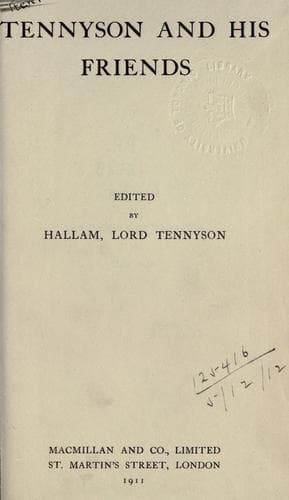
Tennyson, Alfred Tennyson, Baron, 1809-1892 -- Friends and associates
It is certain that Evil has never been more rampant than during the
last century--witness the great French Revolution, subsequent wars,
minor revolutions, and minor wars throughout the globe, the hundreds
of millions wasted on warlike machinery, the countless numbers of
young men sacrificed to the fiends of ambition and racial jealousy,
society honeycombed with frauds, conspiracies, and class animosities,
etc. etc. On the other hand, never has knowledge of all kinds been
more progressive, never have the Arts and Sciences and Literature been
so rapidly multiplied and so various. Never were charitable
institutions more widely extended or practically beneficent. Never, in
short, were the researches into all kinds of truths, especially those
which concern the relations of man to God and his neighbour, more
earnest, and if this seems to contradict the notorious fact that we
are living at present in a world of Atheism and Materialism--which is
the same thing--it does not really do so, for the two movements,
though separate, are parallel and simultaneous. In short, "The Time of
the End" is a transitional state--which will eventually issue in the
triumph of Good over Evil once and for ever.
France he always hated as the leader of materialism, and he would repeat
with a snort of disgust the remark of M. Bert, who, during the debate in
the Chamber on the secularization of Education, observed that it was
superfluous to exclude what did not exist. The debacle of 1870 seemed a
just if tragic retribution.
"One cannot help, however," he wrote on October 19, 1870, "feeling for
beautiful Paris as one would for a Marie Antoinette passing on her way
to execution. There she is in her solitude and in her beauty. Around
her a circle of iron and fire--within her a restless seething of
tumultuous passions embittering the present--her future a prospect of
burning and famine. Such a downfall is unparalleled in history, and
the agonies of her expiration--if things are carried to their bitter
end--promise to equal those of the terrible siege of Jerusalem."
As might be expected, he tended to Conservatism in politics; Home Rule was
anathema, and Disraeli, endeared to him as the possible leader of a
United Israel, he regarded as a sincerer statesman than Gladstone. None
the less he was able to applaud Gladstone's action on the occasion of the
Bulgarian atrocities, though "even he" seemed to have yielded so much
Public-domain text, read in full here on John Shaqi.
Reviews
Reviews
No reviews yet
Be the first to share your thoughts on this work.
Join the Discussion
Join the discussion
Sign in to leave a comment or review.
Sign InorCreate an account