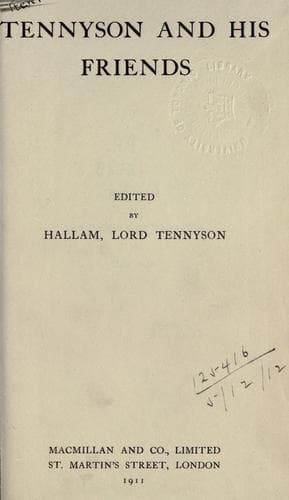
Tennyson, Alfred Tennyson, Baron, 1809-1892 -- Friends and associates
"I have been reading," he wrote to Alfred in 1865, "Pusey's _Daniel
the Prophet_, which (thank God) completely--as I think and as very
many will think with me--disposes of the rickety and crotchety
arguments of those who vainly thought they had found a [Greek: pou
stô] in him whereby to upheave all prophecy and miracle. It is a noble
book from its learning and its logic. I knew he was a holy and
noble-minded and erudite man, but for some reason I had not credited
him with such 'act offence' and powers of righteous satire.... I have
never in my old desultory reading days found such a charm and interest
as in the study of the Queen Science, as Trench calls Theology, and
those who assume that they will find there no food for the mature
reason will be surprised at its large provision for the intellect and
rich satisfaction of the highest imagination. It is reading round
about a subject and not the subject itself which damages the intellect
so much. Maurice said the study of the Prophets had saved him from the
Tyranny of books."
He and his wife also spent much time in the study of Italian, in which
they were assisted by their occasional visits to and from the Frederick
Tennysons. Charles's Italian Grammar is annotated with numberless quaint
rhymes made to fix its rules in his memory. On one page one finds in his
wonderfully neat fluent hand (strangely like those of Frederick and
Alfred):
From use of the following is no ban,
"The fair of the fair is Mistress Ann"
or "Smith's a learned, learned man"
In English or Italian,
Though the English use is far less common
Speaking of Doctor or fine woman.
On another:
Say profeta, profeti
Or else I shall bate ye.
On another a couplet which has all the subtle romance of Edward Lear:
Rare and changeless, firm and few,
Are the Italian nouns in U.
The life at Grasby Vicarage was of the simplest. The hall-floor rattled
with loose tiles, the furniture was reduced to the barest necessities.
Breakfast and lunch were movable feasts, for Charles had all a poet's
carelessness of time, lingering over morning prayers while his agonized
guest saw the bacon cooling to the consistency of marble before his eyes,
and prolonging his mid-day walk to such distances in the study of flower
and bird and butterfly that it sometimes took a half-hour's tolling of the
outdoor bell to recall him. The cook (who in times of scarcity was at the
service of the whole village) must have led a life of irritation, yet
servants stayed long at the Vicarage.
Public-domain text, read in full here on John Shaqi.
Reviews
Reviews
No reviews yet
Be the first to share your thoughts on this work.
Join the Discussion
Join the discussion
Sign in to leave a comment or review.
Sign InorCreate an account